
Early clinical studies suggest that adding a topical exosome product after microneedling can improve skin texture, hydration, and tone more than microneedling alone. But the evidence base is small, short-term, and made up mostly of case series rather than large randomized trials.
Just as importantly, there are currently no FDA-approved exosome products, and exosomes intended for medical use are regulated as drugs and biologics (U.S. Food and Drug Administration, 2019). So the honest answer is: promising, plausible, and not yet proven.
What This Means
Microneedling is a well-established cosmetic procedure. A device with fine needles creates thousands of tiny controlled injuries in the skin, and your body responds by producing new collagen as it heals (American Academy of Dermatology, n.d.).
Microneedling devices intended for aesthetic use are regulated by the FDA as Class II medical devices and must clear a 510(k) review before being marketed (U.S. Food and Drug Administration, 2020).
Exosomes are the newer half of the pairing. They are microscopic vesicles released by cells that carry proteins and genetic signaling material between cells.
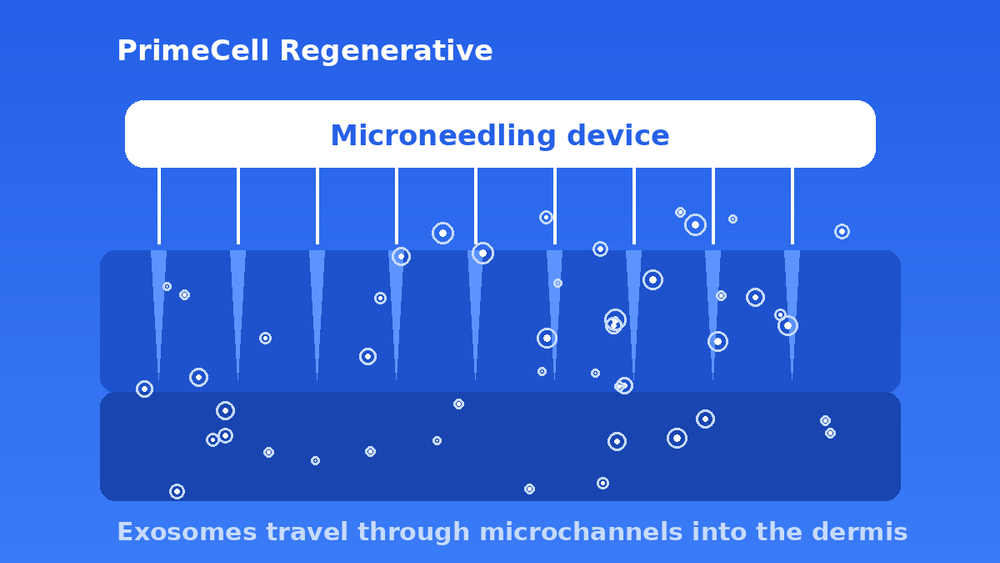
The theory behind combining them is straightforward: the microchannels created by the needles give a topical exosome solution a path past the skin's barrier, so more of it reaches the layers where collagen remodeling happens.
That theory is reasonable. What it is not is settled science. If a clinic tells you this combination is a proven anti-aging treatment, they are getting ahead of the data.
Who May or May Not Be a Candidate
People who tend to do well with microneedling generally have concerns like uneven texture, enlarged-looking pores, mild acne scarring, dull tone, or early fine lines — and realistic expectations about gradual, modest change.
Microneedling is generally not recommended for people with a history of poor wound healing or keloid scarring, or for those who are immunocompromised from a health condition or medication (American Academy of Dermatology, n.d.).
A provider will also typically delay or decline treatment for:
- Active acne.
- Active skin infection.
- Eczema or psoriasis in the treatment area.
- Recent isotretinoin use.
- Pregnancy.
Because exosome products are not FDA-approved, patients who prefer to stick strictly to approved therapies may reasonably choose microneedling on its own.
How Clinicians Evaluate Candidacy
A responsible evaluation is not a five-minute upsell. Expect a provider to take a medical history covering autoimmune conditions, bleeding or clotting disorders, diabetes, cold-sore history, current medications, and prior cosmetic procedures.
They should examine the skin directly — assessing Fitzpatrick skin type, scarring pattern, laxity, and pigmentation risk — because darker skin types carry a higher risk of post-inflammatory hyperpigmentation and may require a gentler protocol.
Baseline photography under consistent lighting matters more than most patients expect, since texture changes are gradual and hard to judge from memory.
A provider should also tell you exactly what exosome product they use, where it is sourced, and what its regulatory status is. If they cannot answer that clearly, that is information too.
Available Options
Microneedling with exosomes is one option among many, and it is not automatically the best one for your concern.
Conventional, well-evidenced alternatives include:
- Prescription topical tretinoin for texture and fine lines.
- Chemical peels for tone and superficial scarring.
- Fractional CO2 or erbium laser resurfacing for deeper texture and scarring.
- Radiofrequency microneedling for laxity.
- Platelet-rich plasma (PRP) with microneedling — which uses your own blood components rather than a manufactured product.
Microneedling alone, with nothing layered on top, remains a legitimate standalone treatment with decades of clinical use behind it. For sun damage and pigmentation, daily broad-spectrum sunscreen does more long-term good than any single in-office session.
Benefits, Limitations, and Risks
The realistic benefits are improvements in skin texture, hydration, elasticity, and pore appearance, developing over weeks to months. Some patients report faster resolution of post-procedure redness when exosomes are applied.
The limitations are significant. Results vary substantially between individuals, typically require a series of sessions, and are maintenance-dependent rather than permanent. Microneedling will not tighten significant laxity or replace surgical treatment.
The risks are real. Expect redness, mild swelling, and a sunburn-like appearance for one to three days. Less commonly:
- Bruising.
- Pinpoint bleeding.
- Infection.
- Hyperpigmentation.
- Granuloma formation.
- Scarring (American Academy of Dermatology, n.d.).
There is an additional layer of risk specific to unapproved exosome products: the FDA has documented serious adverse events, including infections, in patients who received products marketed as containing exosomes, and has cautioned that some clinics make unsubstantiated claims about them (U.S. Food and Drug Administration, 2019).
What the Evidence Shows
Current evidence does establish a consistent early signal. A split-face observational study of nine women found that the side that received exosomes showed greater improvement in texture, hydration, elasticity, and pigmentation than the modality alone, with microneedling plus exosomes among the strongest pairings (Vitale et al., 2025).
A 2026 systematic review of microneedling with exosomes across multiple skin conditions similarly reported early promise, alongside a clear call for larger and better-controlled trials (Dhaliwal et al., 2026).
What the evidence does not establish is equally important. Sample sizes are small — often single digits. Follow-up is typically measured in weeks to months, not years. Exosome products are not standardized between manufacturers, so results from one product do not necessarily transfer to another.
There is no large randomized controlled trial establishing durable benefit, and no exosome product has completed FDA approval for any indication (U.S. Food and Drug Administration, 2019). Anyone offering this procedure should describe it as investigational, not proven.
Recovery and Next Steps
Most people return to normal activity the same day. Plan on redness and mild swelling for roughly 24 to 72 hours, with possible light flaking after.
Aftercare typically includes:
- Skip makeup for about 24 hours.
- Avoid strenuous exercise, saunas, and swimming for two to three days.
- Hold retinoids and exfoliating acids for about a week.
- Use broad-spectrum sunscreen diligently — freshly treated skin is more vulnerable to UV-driven pigmentation.
Collagen remodeling is slow. Meaningful change is usually judged at three to six months and after a series of sessions, not after one appointment.
Orlando Considerations
Florida regulates who may perform microneedling. Devices that penetrate the skin beyond superficial cosmetic depth fall under the practice of medicine and must be performed by a licensed physician, physician assistant, or advanced practice registered nurse.
They may also be performed by appropriately trained staff working under physician supervision and delegation, as governed by Florida's Medical Practice Act (Florida Legislature, 2025). Ask who will actually be holding the device and who the supervising physician is.
Central Florida's UV load is the other local factor.
Year-round sun exposure raises the risk of post-inflammatory hyperpigmentation after any resurfacing procedure, which is a practical argument for daily sunscreen, sun avoidance in the week after treatment, and a conservative protocol for patients with medium-to-deep skin tones.
Frequently Asked Questions
How much does microneedling with exosomes cost?
Pricing varies widely by market, provider, and the exosome product used, and it is typically higher per session than microneedling alone. Because it is a cosmetic procedure, it is not covered by insurance. Ask for the full per-session and per-package price in writing.
How many sessions will I need?
Most protocols involve a series of about three sessions spaced roughly four weeks apart, with maintenance thereafter. Your provider should set expectations based on your specific concern.
Is microneedling with exosomes safe?
Microneedling itself has a well-characterized safety profile when performed by trained providers.
The exosome component is less certain — no exosome product is FDA-approved, and the FDA has reported serious adverse events from unapproved exosome products (U.S. Food and Drug Administration, 2019).
Discuss this tradeoff directly with your provider.
Does it hurt?
Topical numbing cream is applied beforehand, and most patients describe the sensation as pressure or mild scratching rather than sharp pain.
How soon will I see results?
Immediate glow is mostly swelling and hydration. Real collagen-driven change appears gradually over roughly three to six months.
Ready to Learn More?
If you would like to talk through whether microneedling — with or without exosomes — makes sense for your skin, PrimeCell Regenerative offers consultations in Orlando. We are happy to walk you through the options and the evidence.
References
American Academy of Dermatology. (n.d.). Microneedling can fade scars, uneven skin tone, and more. https://www.aad.org/public/cosmetic/scars-stretch-marks/microneedling-fade-scars
Dhaliwal, N. K., Moothathamby, T., Sokhal, B. S., & Gkini, M. A. (2026). The use of microneedling with exosomes in dermatology: A systematic review. Journal of Cosmetic Dermatology, 25(4), e70881. https://doi.org/10.1111/jocd.70881
Florida Legislature. (2025). The 2025 Florida Statutes: Chapter 458, Medical practice. https://www.leg.state.fl.us/statutes/index.cfm?App_mode=Display_Statute&URL=0400-0499/0458/0458.html
U.S. Food and Drug Administration. (2019, December 6). Public safety notification on exosome products. https://www.fda.gov/vaccines-blood-biologics/safety-availability-biologics/public-safety-notification-exosome-products
U.S. Food and Drug Administration. (2020, November). Regulatory considerations for microneedling products: Guidance for industry and Food and Drug Administration staff. https://www.fda.gov/regulatory-information/search-fda-guidance-documents/regulatory-considerations-microneedling-products
Vitale, M., Ruri, P., Marini, S., Zappia, E., & Yi, K.-H. (2025). Clinical outcomes of exosome-augmented microneedling and laser therapies in full-face skin rejuvenation: A split-face observational study. Journal of Craniofacial Surgery, 36(7), e1133-e1138. https://doi.org/10.1097/SCS.0000000000011807
This article is for educational purposes only and is not medical advice, a diagnosis, or a treatment recommendation. Exosome products are not FDA-approved and are not approved to prevent, treat, or cure any disease or condition; any use of them is investigational.
Microneedling is a medical procedure with real risks and no guaranteed outcome — results vary by patient. Consult a licensed physician or qualified provider to discuss your candidacy, alternatives, and risks before proceeding. Medically reviewed by Kenny Chantasi, DO. Last medically reviewed: August 04, 2026.
Related reading
- Are Exosomes FDA Approved? What Patients Should Know
- Best Korean Facial Treatments to Consider
- Exosome Therapy vs. Stem Cell Therapy: What's the Difference?
- How Long Does It Take to See Results From Exosome Therapy?
- What Regenerative Aesthetics Really Means
More questions answered on the PrimeCell patient blog, or see frequently asked questions.
Related services at PrimeCell
PrimeCell is a physician-led practice in Orlando. Candidacy for any procedure is determined at an in-person evaluation.
Ready when you are
Talk with a physician about your options
Have questions about whether this is right for you? Book a consultation with Dr. Chantasi, or call the clinic and we'll talk it through.
Orlando, FL · Mon–Fri 10am–6pm