
Aesthetics · Neurotoxins
Botox, Xeomin & Jeuveau in Orlando: aesthetic and therapeutic
Softer expression lines without losing your expression. Dr. Kenny Chantasi uses Botox Cosmetic, Xeomin and Jeuveau, maps each dose to how your face moves, tells you which areas are FDA-approved and which are off-label, and gives you the plan and a written estimate first. As a PM&R and pain physician, Dr. Chantasi also performs therapeutic botulinum toxin injections.
Scheduling opens securely in Prospyr · starts with the Aesthetic Goals Assessment
What it is
What neurotoxin treatment does
Short answer
For aesthetic care PrimeCell uses three botulinum toxin products: Botox Cosmetic (onabotulinumtoxinA, Allergan Aesthetics), Xeomin (incobotulinumtoxinA, Merz) and Jeuveau (prabotulinumtoxinA-xvfs, Evolus). All three are prescription drugs. Tiny doses temporarily reduce the nerve signal to selected muscles, which softens lines caused by movement, such as frown lines, forehead lines and crow’s feet. The effect usually builds over one to two weeks and fades over roughly three to four months.
“Botox” is often used as a general term, but BOTOX® Cosmetic is one brand within a broader family of prescription botulinum toxin products. Each product has its own formulation, dosing units, approved uses and clinical characteristics, and units of one cannot be converted directly into units of another. Dysport and Daxxify are other FDA-approved products; PrimeCell does not use them, and they are mentioned here only for comparison.
For appearance, neurotoxins soften dynamic lines, the ones made by expression. They do little for lines etched into the skin at rest, for texture or for volume loss. Those respond to other tools on our regenerative aesthetics options map. Medical uses, such as chronic migraine and spasticity, are covered separately under therapeutic uses.
What it is
- A temporary, non-surgical way to soften expression lines
- A prescription drug given by a physician after an evaluation
- Dosed to your muscle strength and the movement you want to keep
- For some products and diagnoses, an FDA-approved medical therapy (see therapeutic uses)
What it is not
- A filler: it does not add volume or lift sagging skin
- Permanent: it wears off, and maintenance is your choice
- A unit package: “20 units” means different things for different products and faces
- A spa service: it carries a boxed warning and needs medical screening
By facial region
Precision treatment, area by area
Every plan begins with facial movement, symmetry, muscle strength, skin quality and how much movement you want to keep. It does not begin with a standard unit package.
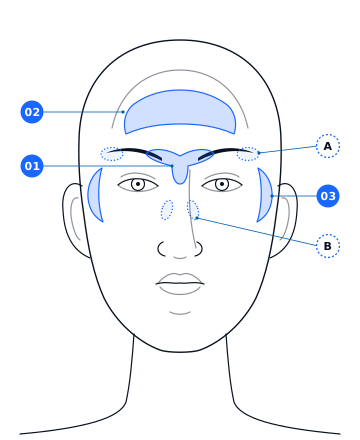
Upper face · rows 01–03
- 01Frown lines. Procerus and corrugator muscles, between the brows.
- 02Forehead lines. Frontalis muscle, kept well above the brows to protect brow position.
- 03Crow’s feet. Outer orbicularis oculi muscle, beside each eye.
- ABrow position. Tail of the brow. Varies by patient; off-label for all three products.
- BBunny lines. Nasalis muscle on the sides of the upper nose. Varies by patient; off-label.
Solid outline: typical area. Dotted: varies by patient. FDA status for 01–03 is given in each row below. Illustration of typical injection areas, for education. Not a photograph or a result. Where and how much is injected is decided at your evaluation.
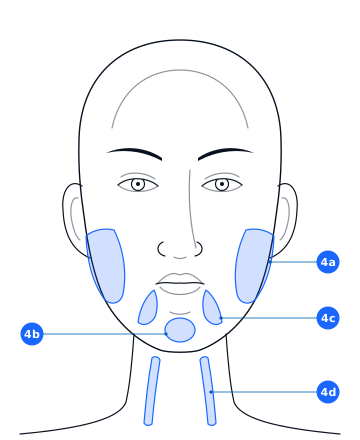
Lower face & neck · row 04
- 4aMasseter. Jaw muscle at the angle of the jaw, for clenching or jaw contouring. Off-label.
- 4bMentalis. Chin muscle, for chin dimpling. Off-label.
- 4cDepressor anguli oris. Below each corner of the mouth, for downturned corners. Off-label.
- 4dPlatysma bands. Vertical neck bands. Botox Cosmetic is FDA-approved for moderate to severe bands in adults; off-label for Xeomin and Jeuveau.
Every zone is shown on both sides. Illustration of typical injection areas, for education. Not a photograph or a result. Where and how much is injected is decided at your evaluation.
- 02
Forehead lines
Horizontal lines, treated while balancing brow position. Too much here can make the brows feel heavy, so dosing is usually conservative. Botox Cosmetic and Xeomin are approved for moderate to severe forehead lines; Jeuveau is not, so using it here is off-label.5,6,8
FDA-approved · Botox Cosmetic & Xeomin Off-label · Jeuveau
- 03
Crow’s feet
- 04
Lower face, jaw & neck
Chin dimpling, gummy smile, “lip flip,” jawline slimming and neck (platysma) bands. In October 2024 the FDA approved Botox Cosmetic for moderate to severe platysma bands, the vertical bands connecting the jaw and neck, in adults.5,7 Other lower-face uses are off-label and need more careful discussion. Jaw clenching and TMJ pain are medical concerns, covered under therapeutic uses.
Neck bands · Botox Cosmetic Other areas off-label
Jeuveau outside the frown lines
Jeuveau is FDA-approved only for moderate to severe frown lines in adults.8 Dr. Chantasi may use Jeuveau off-label in other areas, such as the forehead, crow’s feet or lower face, when he judges it appropriate for you. Off-label use is discussed with you and consented in writing before treatment. The FDA has not reviewed Jeuveau’s safety or effectiveness in those areas.14 If you prefer a product that is FDA-approved for the area, Botox Cosmetic and Xeomin are approved for forehead lines and crow’s feet.5,6
Approval is product-specific: an area on one product’s FDA label may be off-label for another. For example, neck bands are on Botox Cosmetic’s label but not Xeomin’s, and Jeuveau’s label covers frown lines only. You will know which product is recommended and why.
Regulatory status
Prescription drugs, with product-specific labels
Every botulinum toxin product has its own FDA label: the conditions it is approved for, doses, contraindications and a boxed warning. Using an approved drug outside its label is legal and common, but it should be disclosed to you.
| Use | Examples | Status |
|---|---|---|
| Cosmetic, upper face | Frown lines (Botox Cosmetic, Xeomin and Jeuveau); forehead lines and crow’s feet (Botox Cosmetic and Xeomin)5,6,8 | FDA-approved |
| Cosmetic, neck | Moderate to severe platysma (neck) bands (Botox Cosmetic) | FDA-approved |
| Cosmetic, other areas | Chin, lip, gummy smile, jawline; any area other than frown lines for Jeuveau | Off-label |
| Therapeutic | Chronic migraine, spasticity, cervical dystonia, severe underarm sweating, blepharospasm and others, for specific products (details below)1,6 | FDA-approved |
| TMJ, bruxism & other pain | Jaw-muscle (masseter) injections, myofascial and other pain | Off-label |
The three aesthetic products differ: Botox Cosmetic’s label covers frown lines, forehead lines, crow’s feet and neck bands; Xeomin’s covers the three upper-face lines; Jeuveau’s covers frown lines only.5,6,8 Cosmetic and therapeutic dosing are not interchangeable.
PrimeCell is a self-pay practice and does not bill insurance. If you are seeking coverage for a medical indication such as chronic migraine, read does insurance cover Botox? and can Botox treat migraines?
Therapeutic botulinum toxin
Therapeutic uses of botulinum toxin
Botulinum toxin was a medical drug before it was a cosmetic one. Dr. Chantasi is board-certified in Physical Medicine & Rehabilitation and in Pain Medicine, the specialties that manage spasticity and chronic pain, and performs the therapeutic injections below personally, after an evaluation. This section is education: some of these uses are FDA-approved, and some are off-label.
Short answer
Botox (onabotulinumtoxinA) is FDA-approved for preventing headaches in adults with chronic migraine and for spasticity in patients 2 years and older; Xeomin is approved for upper limb spasticity.1,6 No botulinum toxin is FDA-approved for TMJ disorders, bruxism or most other pain. Those uses are off-label, and the studies are mixed. Jeuveau has no therapeutic approval, so PrimeCell uses it for aesthetic care only.8 Dr. Chantasi can evaluate and inject children 2 years and older with spasticity.
- 01
Chronic migraine
Botox is FDA-approved to prevent headaches in adults with chronic migraine: headache on 15 or more days a month, lasting 4 hours a day or longer. It is not approved for episodic migraine (14 or fewer headache days a month), where its safety and effectiveness have not been established.1 In the pivotal PREEMPT trials, injections every 12 weeks reduced headache days more than placebo injections, but the average difference was modest: pooled across both trials, headache days fell by 8.4 per 28 days with Botox, compared with 6.6 with placebo, after 24 weeks.9
Dr. Chantasi performs migraine injections after an evaluation that confirms the pattern, usually with a headache diary, and reviews the preventive medicines you have already tried. New, changing or unusual headaches may need neurology review or imaging first. Can Botox help migraines?
FDA-approved · Botox, adults
- 02
Spasticity
Spasticity is muscle stiffness and overactivity after a stroke, brain or spinal cord injury, multiple sclerosis or cerebral palsy. Botox is FDA-approved for spasticity in patients 2 years and older, and Xeomin for upper limb spasticity in patients 2 years and older.1,6 The Botox label notes that it has not been shown to improve upper-limb function, or motion at a joint with a fixed contracture.1 Injections are usually one part of a plan that includes stretching, therapy and bracing.
Spasticity management is core PM&R work. Dr. Chantasi performs these injections after examining muscle tone, range of motion, gait and daily function, and sets goals with you and your therapists. Spasticity: causes, symptoms and care.
Children with spasticity. Dr. Chantasi can evaluate and inject children 2 years and older with spasticity. Botox is FDA-approved for spasticity in patients 2 years and older, and Xeomin for upper limb spasticity in patients 2 years and older; Xeomin is not approved for the legs in children.1,6 A child’s dose is calculated from body weight, within each product’s labeled limits.1,6 The boxed warning states that the risk of distant spread of toxin effect is probably greatest in children treated for spasticity, so parents are told before the visit which symptoms need immediate medical attention.1,6 Dr. Chantasi coordinates with the child’s neurologist, pediatrician and therapy team, and a parent or legal guardian gives written consent.
PrimeCell is self-pay and does not bill insurance, including for children. Families who want insurance to cover their child’s injections may use an in-network provider instead.
FDA-approved · Botox (2 years and older); Xeomin (upper limb, 2 years and older)
- 03
TMJ, masseter & bruxism
No botulinum toxin is FDA-approved for temporomandibular (TMJ) disorders or bruxism (clenching and grinding). Small doses into the masseter, and sometimes the temporalis, muscles are used off-label for some patients with jaw-muscle pain or clenching. Studies are mixed. A 2024 umbrella review found moderate evidence of benefit for muscle-related TMJ pain but advised keeping it as a last option after conservative care,10 and a 2023 meta-analysis in bruxism found that effects faded by about six months.11 It does not change the joint itself. Possible effects include temporary chewing weakness and a change in lower-face shape.
Dr. Chantasi performs jaw-muscle injections after a jaw, neck and bite evaluation, usually once a night guard, jaw exercises and other conservative steps have been tried, and can coordinate with your dentist.
Off-label · limited or mixed evidence
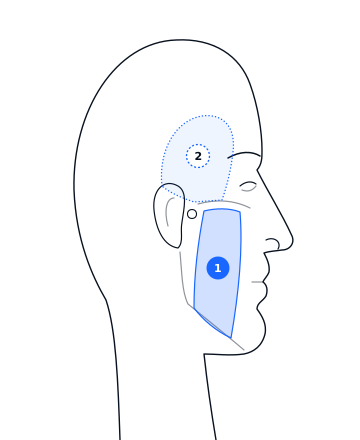
Jaw muscles, side view
- 1Masseter. The main chewing muscle, over the back of the jaw.
- 2Temporalis. Fan-shaped muscle at the temple, sometimes included. Varies by patient.
- Jaw joint (TMJ). Shown for orientation. The joint itself is not injected.
Both muscles are used off-label for clenching, grinding and jaw-muscle pain. Illustration of typical injection areas, for education. Not a photograph or a result. Where and how much is injected is decided at your evaluation.
- 04
Myofascial & other pain
Chronic migraine is the only pain-related FDA-approved use of botulinum toxin.1 For myofascial pain (painful muscle knots and trigger points), a Cochrane review found the evidence inconclusive.12 Small trials in some kinds of nerve pain, such as pain after shingles or painful diabetic neuropathy, have shown benefit, but the evidence is limited.13 These uses are off-label and are usually considered only after standard options.
Dr. Chantasi performs these injections after a pain evaluation, alongside other care such as trigger-point injections and nerve blocks and rehabilitation. Neuropathy & nerve pain.
Off-label · limited or mixed evidence
What off-label means at PrimeCell
Off-label means using an FDA-approved drug for a use, body area, dose or age group that is not in its FDA label. It is legal and common: the FDA says that once it approves a drug, healthcare providers generally may prescribe it for an unapproved use when they judge that it is medically appropriate for their patient.14,15 It also means the FDA has not reviewed the drug for that use and has not determined that it is safe and effective for it.14 The evidence varies from use to use; for the jaw and pain uses above it is limited or mixed.
Before any off-label injection, Dr. Chantasi goes over:
- why he is suggesting it for you, and what the studies do and do not show;
- the alternatives, including FDA-approved options and no injection;
- the risks, including the boxed warning on distant spread of toxin effect.
You then sign a written consent that names the product, the area and the fact that the use is off-label. You can ask questions, take time to decide, or say no.
| Product | Approved aesthetic uses (adults) | Approved therapeutic uses |
|---|---|---|
| Botox Cosmetic / Botox (onabotulinumtoxinA) | Frown lines, crow’s feet, forehead lines, neck (platysma) bands5 | Chronic migraine (adults); spasticity (2 years and older); cervical dystonia; severe underarm sweating; blepharospasm and strabismus; overactive bladder and neurogenic bladder conditions1 |
| Xeomin (incobotulinumtoxinA) | Frown lines, forehead lines, crow’s feet6 | Upper limb spasticity (2 years and older); chronic sialorrhea (drooling); cervical dystonia; blepharospasm6 |
| Jeuveau (prabotulinumtoxinA-xvfs) | Frown lines only8 | None8 |
PrimeCell is a self-pay practice. You receive a written estimate before treatment, and PrimeCell does not bill insurance. Therapeutic doses are often much larger than cosmetic doses. Many insurance plans cover Botox for approved diagnoses such as chronic migraine, so if you want your plan to pay, ask an in-network specialist first. Does insurance cover Botox?
The listed uses are not the only approved uses; cervical dystonia, underarm sweating, eyelid, eye-muscle and bladder indications are usually managed by the matching specialist, and Dr. Chantasi will refer you when that is the better route. A licensed physician decides candidacy after an evaluation.
The PrimeCell Aesthetic Goals Assessment
How we decide what, where and how much
Every neurotoxin consultation starts with your goals: what you want to change, and what you want to keep. That conversation decides whether treatment is appropriate, which product fits, and how conservative the plan should be.
Consultation & movement
Medical history, medications, prior injectables, facial anatomy, symmetry, muscle strength and the result you want.
Personal mapping
Injection points and dose chosen for your movement pattern rather than a one-size-fits-all template.
Plan & cost in writing
The product, the areas, which of them are off-label, the risks and the anticipated cost, before anything is done.
Follow-up
A check-in to assess balance and response, and the Aesthetic Outcomes Follow-Up on whether the result met your goals.
Aesthetic medicine increasingly uses validated patient-reported tools to measure whether a treatment met a patient’s goals, not just whether it looked “correct” on examination.3 A 2019 review found that most cosmetic botulinum toxin studies still rely on simple satisfaction ratings rather than those instruments.4 The PrimeCell Aesthetic Outcomes Follow-Up has no published results yet. Findings will be shared only when enough patients have completed follow-up to report them honestly.
Treatment experience
What the visit is like
Most aesthetic sessions fit into a short office visit. A very fine needle places small amounts into the targeted muscles. Most people describe it as quick pinches.
- Before
- Come with a clean face. To reduce bruising, avoid alcohol and, when medically appropriate, blood-thinning supplements for a short time beforehand. Never stop a prescribed medication without your doctor’s advice.
- During
- A final check of the plan, then a few minutes of injections. You can usually return to work the same day.
- After
- Stay upright for several hours. Avoid rubbing the area, strenuous exercise, saunas and facials for the rest of the day.
Timeline
When you see a change, and how long it lasts
Timing varies with the product, dose, area, muscle strength and your treatment history. These are typical ranges, not promises.
Day 0
Small bumps at injection points settle within about an hour. Pinpoint bruises are possible.
Days 3–5
Many people begin to notice softening.
About 2 weeks
Full effect. This is when a follow-up to check balance makes sense.
3–4 months
Movement gradually returns. Whether and when to repeat treatment is your choice.
Candidacy
Who may, or may not, be a candidate
Often a reasonable fit
- Adults who want temporary softening of expression lines
- People who want to look rested, not “frozen”
- Adults with chronic migraine, adults and children 2 years and older with spasticity, and patients with jaw-muscle or muscle pain, who want to discuss therapeutic injections
- Realistic expectations about temporary, gradual change
Postpone or avoid when there is
- Active infection or inflammation at a planned injection site
- Prior allergy or significant reaction to a botulinum toxin product
- Pregnancy, plans for pregnancy, or breastfeeding
- A neuromuscular disorder, or conditions affecting swallowing or breathing
- Medications or supplements that raise bruising risk or interact with treatment
- Recent neurotoxin treatment from another provider
Risks & limitations
What can go wrong
Most side effects are mild and temporary, and they depend on where the injection goes. In the face: bruising, tenderness, headache and, less commonly, a heavy brow, a drooping eyelid or asymmetry. For migraine: neck pain and headache. For spasticity: pain in the injected limb and weakness of nearby muscles. For the jaw: temporary chewing weakness. These usually improve as the effect wears off.
Boxed warning: distant spread of toxin effect
The FDA labels for Botox, Botox Cosmetic, Xeomin, Jeuveau and every other botulinum toxin product carry a boxed warning that effects can, rarely, spread beyond the injection area, hours to weeks after treatment. The labels note that the risk is probably greatest in children treated for spasticity, but symptoms can also occur in adults. Difficulty swallowing, speaking or breathing, widespread weakness, double vision or other severe neurological symptoms need immediate medical attention.1,5,6,8
Product source matters. In 2024 the FDA warned that counterfeit Botox had been found in several states, with serious adverse events.2 Whoever treats you should be able to tell you which product you are receiving and that it is licensed. Units of one product are not interchangeable with units of another. Results vary, and no outcome or duration is guaranteed.
Cost
How pricing is determined
Cost depends on the product selected, the number of units, the areas treated and your goals. After the good-faith exam you receive a written plan and estimate before treatment, so there is no surprise at checkout.
Comparing clinics by price per unit can mislead, because units are not equivalent between products and the dose you need depends on your muscles. All care at PrimeCell, cosmetic and therapeutic, is self-pay, and PrimeCell does not bill insurance. Qualifying patients can use Cherry payment plans, and PrimeCell members can direct their allowance toward eligible aesthetic services.
Go deeper
Before your first neurotoxin injection
Physician-reviewed, with sources.
Questions
Botox & neurotoxin FAQ
Will I look frozen?
The goal is not to eliminate every expression. Careful dosing and placement can soften selected movement while preserving a natural appearance.
When will I see results?
Many patients begin noticing changes within several days, while the full effect may take approximately one to two weeks.
How long do results last?
Aesthetic effects often last around three to four months, but duration varies by muscle strength, dose, product, area and treatment history.
Which neurotoxins does PrimeCell use?
Botox Cosmetic, Xeomin and Jeuveau for aesthetic care, and Botox or Xeomin for therapeutic uses. Which product suits you depends on the area, the product’s FDA label, your history and your goals. PrimeCell does not use Dysport or Daxxify.
Do you offer Jeuveau?
Yes. Jeuveau (prabotulinumtoxinA-xvfs, Evolus) is FDA-approved for moderate to severe frown lines between the brows in adults, and for nothing else. Dr. Chantasi may use it off-label in other areas, such as the forehead, crow’s feet or lower face, when he judges it appropriate; that use is discussed and consented in writing before treatment, and the FDA has not reviewed Jeuveau’s safety or effectiveness in those areas. It has no therapeutic approvals. Its units are not interchangeable with Botox or Xeomin units.
Are Botox, Dysport, Xeomin, Jeuveau and Daxxify equivalent?
No. Their formulations and dosing units are not interchangeable, and their FDA-approved uses differ. The recommended product depends on clinical assessment and treatment goals.
Which areas are FDA-approved?
All three products are FDA-approved for moderate to severe frown lines in adults. Botox Cosmetic and Xeomin are also approved for forehead lines and crow’s feet, and Botox Cosmetic for moderate to severe neck (platysma) bands. Other uses, such as the chin, lips and jawline, or Jeuveau outside the frown lines, are off-label, which is legal but should be disclosed to you.
Is Botox for TMJ FDA-approved?
No. No botulinum toxin is FDA-approved for TMJ disorders or bruxism. Jaw-muscle injections are used off-label for some patients with jaw-muscle pain or clenching, and the studies are mixed. Dr. Chantasi discusses them after an evaluation, usually once conservative care such as a night guard has been tried.
Does PrimeCell do Botox for migraines or spasticity?
Yes. Dr. Chantasi performs therapeutic injections after an evaluation. Botox is FDA-approved for chronic migraine in adults and for spasticity, and Xeomin for upper limb spasticity. PrimeCell is self-pay with a written estimate and does not bill insurance, so if you want your plan to pay, ask an in-network specialist.
Do you see children for spasticity?
Yes. Dr. Chantasi can evaluate and inject children 2 years and older with spasticity. Botox is FDA-approved for spasticity in patients 2 years and older, and Xeomin for upper limb spasticity in patients 2 years and older. Doses are based on the child’s weight, a parent or legal guardian gives written consent, and care is coordinated with the child’s neurologist and therapists. PrimeCell is self-pay and does not bill insurance; families who want insurance coverage may use an in-network provider.
What does off-label mean?
Using an FDA-approved drug for a use, area, dose or age group that is not in its label. It is legal and common, but the FDA has not reviewed the drug for that use. At PrimeCell, off-label use is explained, with its alternatives and risks, and consented in writing before treatment.
How is pricing determined?
Cost depends on the selected product, number of units, treatment areas and clinical goals. A written treatment plan and estimate are reviewed with you after the good-faith exam and before treatment.
Does PrimeCell check in after treatment to see how I feel about my results?
Yes. Every neurotoxin consultation starts with the PrimeCell Aesthetic Goals Assessment, and patients who move forward are invited into the PrimeCell Aesthetic Outcomes Follow-Up to check whether the result matched their goals and whether anything needs attention. We do not publish outcome statistics until we have enrolled enough patients to report them honestly.
Look refreshed. Still look like yourself.
Begin with a personal neurotoxin consultation with Dr. Chantasi: your goals, your movement, your options and the cost, in writing.
$97Initial physician consultation · offer valid through October 31, 2026
THE PATIENT AND ANY OTHER PERSON RESPONSIBLE FOR PAYMENT HAS A RIGHT TO REFUSE TO PAY, CANCEL PAYMENT, OR BE REIMBURSED FOR PAYMENT FOR ANY OTHER SERVICE, EXAMINATION, OR TREATMENT THAT IS PERFORMED AS A RESULT OF AND WITHIN 72 HOURS OF RESPONDING TO THE ADVERTISEMENT FOR THE FREE, DISCOUNTED FEE, OR REDUCED FEE SERVICE, EXAMINATION, OR TREATMENT.
References
- Allergan. BOTOX (onabotulinumtoxinA) prescribing information, revised 10/2024: therapeutic indications (including chronic migraine and spasticity), limitations of use and boxed warning. DailyMed, U.S. National Library of Medicine; accessed September 23, 2026. dailymed.nlm.nih.gov
- U.S. Food and Drug Administration. Counterfeit version of Botox found in multiple states (2024). fda.gov
- Pusic et al. Clin Plast Surg. 2013 (patient-reported outcome measures in aesthetic practice). doi:10.1016/j.cps.2012.12.001
- Wang and Rieder. Dermatol Surg. 2019 (review of outcome measures in cosmetic botulinum toxin studies). doi:10.1097/dss.0000000000001878
- BOTOX Cosmetic (onabotulinumtoxinA) prescribing information: indications (glabellar, lateral canthal and forehead lines; platysma bands) and boxed warning. DailyMed, U.S. National Library of Medicine. dailymed.nlm.nih.gov
- XEOMIN (incobotulinumtoxinA) prescribing information, revised June 2026: indications (upper facial lines; chronic sialorrhea, upper limb spasticity in patients 2 years and older, cervical dystonia, blepharospasm) and boxed warning. DailyMed, U.S. National Library of Medicine. dailymed.nlm.nih.gov
- AbbVie. BOTOX Cosmetic (onabotulinumtoxinA) receives FDA approval for moderate to severe vertical bands connecting the jaw and neck (platysma bands). October 18, 2024. news.abbvie.com
- JEUVEAU (prabotulinumtoxinA-xvfs) prescribing information: indication (moderate to severe glabellar lines in adults only; approved February 2019) and boxed warning. DailyMed, U.S. National Library of Medicine. dailymed.nlm.nih.gov; Drugs@FDA label: accessdata.fda.gov
- Dodick DW et al. OnabotulinumtoxinA for treatment of chronic migraine: pooled results from the double-blind, randomized, placebo-controlled phases of the PREEMPT clinical program. Headache. 2010;50(6):921–936. doi:10.1111/j.1526-4610.2010.01678.x
- De la Torre Canales G et al. Drugs. 2024;84(7):779–809 (umbrella review of botulinum toxin type A in temporomandibular disorders). doi:10.1007/s40265-024-02048-x
- Chen Y et al. Aesthetic Plast Surg. 2023;47(2):775–790 (systematic review and meta-analysis of botulinum toxin in bruxism). doi:10.1007/s00266-023-03256-8
- Soares A et al. Botulinum toxin for myofascial pain syndromes in adults. Cochrane Database Syst Rev. 2014;(7):CD007533. doi:10.1002/14651858.CD007533.pub3
- Park J, Park HJ. Toxins. 2017;9(9):260 (narrative review of botulinum toxin in neuropathic pain). doi:10.3390/toxins9090260
- U.S. Food and Drug Administration. Understanding unapproved use of approved drugs “off label” (updated February 5, 2018). fda.gov
- Wittich CM, Burkle CM, Lanier WL. Ten common questions (and their answers) about off-label drug use. Mayo Clin Proc. 2012;87(10):982–990. doi:10.1016/j.mayocp.2012.04.017
Important prescription drug notice: Botulinum toxin products are prescription drugs with product-specific approved indications, contraindications, warnings and prescribing information. BOTOX® and BOTOX® Cosmetic are registered trademarks of their respective owner; XEOMIN® and JEUVEAU® are registered trademarks of their respective owners; Dysport and Daxxify are trademarks of their respective owners and are not used at PrimeCell. Some facial and therapeutic applications described here are off-label, including all use of botulinum toxin for TMJ disorders, bruxism and pain other than chronic migraine. Results vary, and no outcome or duration is guaranteed.
Medically reviewed by Kenny Chantasi, DO, on September 23, 2026. General education only; not medical advice. Candidacy is determined at an individual evaluation.