
Industry Insights · Clinical Practice & Operator Guidance
PDRN, PN & PLLA: A 2026 Regenerative Aesthetics Field Guide
Published · Written and medically reviewed by Dr. Kenny Chantasi, DO
Prefer the PDF version? Download the full 34-page field guide →
Author's note: I'm a physician — board-certified in physical medicine and rehabilitation with subspecialty certification in pain medicine — practicing regenerative and interventional medicine in Orlando. Regenerative injectables sit at an awkward intersection: the biology is genuinely good, and the training material around it is genuinely bad. Most of what circulates is either a textbook chapter that lumps three unrelated agents into one paragraph, or a manufacturer deck that only discusses the product it's selling.
This guide is the version I wanted when I started building a regenerative service line: written for aesthetic physicians, nurse injectors, PAs, and medical directors who have to make dosing, sequencing, and complication decisions on a real schedule. Every protocol here is illustrated through three composite patients — Maria, Diane, and Robert — who are constructed from typical Central Florida panel presentations, not from any identifiable individual.
It is not medical advice and it is not written for patients; if you're a patient researching care, start with our patient education library instead. Verify all dosing and dilutions against current product labeling and your own medical director before clinical use.
What Changed Between 2022 and 2026
If your regenerative injectable protocols were written before 2024, three things have changed underneath you, and all three are load-bearing:
- Immediate reconstitution of PLLA is validated. The old instruction to hydrate Sculptra overnight — sometimes 24 to 72 hours — is no longer required. A 2024 safety study reported a 0.36% nodule rate across 274 treatments using immediate reconstitution at 8–9 mL (Casabona et al., PMC). If your SOP still says "hydrate overnight," it is running on 2011 evidence.
- Dilution volume became the dominant safety variable. Concentrated preparations under 8 mL per facial vial carry meaningfully higher nodule risk, and a Brazilian cohort found non-physician injectors had roughly a 3× higher nodule rate than physicians — technique-dependent, not product-dependent (Aesthetic Medicine UK PLLA consensus, Feb 2025).
- PDRN and PN stopped being interchangeable on the evidence. A 2025 comparative review formally separated short-fragment polydeoxyribonucleotide from long-chain polynucleotide on mechanism and indication (Kim et al., PMC), while a 16-trial systematic review concluded PDRN evidence remains at an "embryonic stage" for standardized dosing (Ceccarelli et al., EJPS).
Read together, those three findings say something uncomfortable: most of the nodule rate difference between a good clinic and a bad one is not the product. It's the protocol.
Table of Contents
- Fundamentals: what each agent actually does
- The product comparison — the injector's quick reference
- Depth and placement: the strongest safety lever you have
- The timeline problem: why good results still generate complaints
- The five-step clinical protocol
- Three composite cases: Maria, Diane, and Robert
- Adverse events: the honest numbers
- The complication playbook
- Business and operational realities
- Medical-marketing compliance: LegitScript, Google, and Meta
- The eight-item audit checklist
- Where the evidence still has gaps
- Conclusion
- References
1. Fundamentals: What Each Agent Actually Does
Between 2018 and 2026, the aesthetic injectable market quietly reorganized itself around a different question. It stopped being how do we add volume? and started being how do we restore the tissue? That shift — from filler to regeneration — is why polydeoxyribonucleotide (PDRN), long-chain polynucleotides (PN), and poly-L-lactic acid (PLLA) now share bench space with hyaluronic acid in most sophisticated clinics.
The three look nearly identical on a service menu. Skin booster. Biostimulator. Regenerative injectable. They do biologically distinct things, and conflating them is the root cause of most disappointing outcomes in this category.
PDRN — the signal molecule
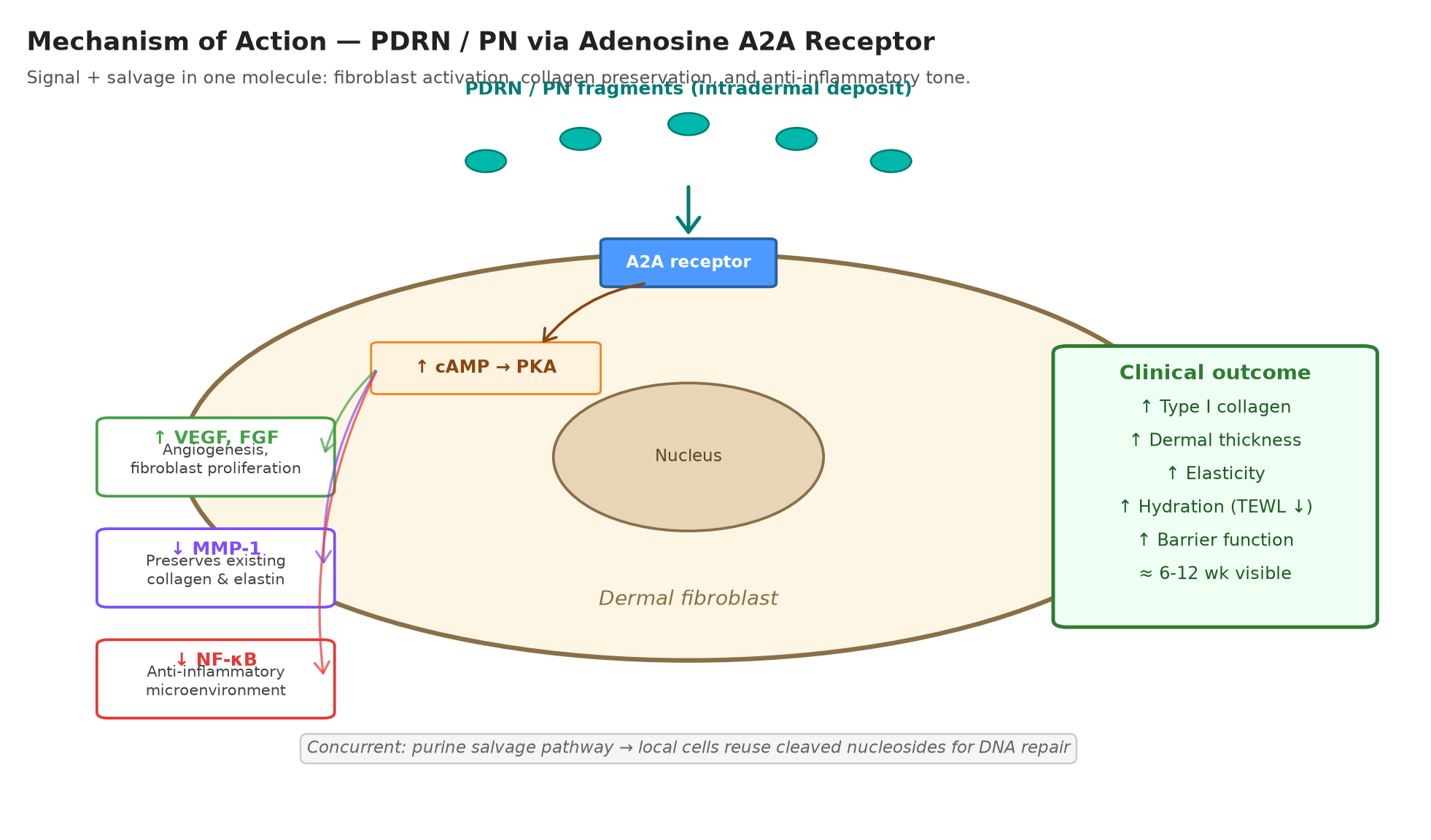
PDRN is a purified salmon-derived DNA fragment cocktail, 50–2,000 base pairs, delivered intradermally in microdroplets. It works through two overlapping mechanisms (Kim et al., PMC; Ninaveli knowledge hub on A2A signaling).
Adenosine A2A receptor activation. PDRN binds the A2A receptor on fibroblasts, endothelial cells, and immune cells. That binding elevates intracellular cAMP, activates protein kinase A, upregulates VEGF and FGF, downregulates MMP-1, and suppresses NF-κB inflammatory signaling. Clinical translation: fibroblasts wake up, make more Type I collagen, and stop destroying what's already there. Recent series measure a 25–35% increase in collagen synthesis over 8–12 weeks.
Purine salvage. As endonucleases cleave PDRN fragments into free nucleosides, local cells reabsorb them as building blocks for their own DNA repair. The molecule delivers fuel and signal simultaneously — which is a genuinely unusual property, and the reason PDRN performs well as a post-procedure recovery adjunct.
Think of PDRN as a tissue-repair primer. It improves what already exists — hydration, elasticity, barrier function, microcirculation. It does not build structural volume. If a patient's chief complaint is a hollow midface, PDRN is the wrong answer no matter how well it's injected.
PN long-chain (Rejuran-type) — the scaffold
PN products use higher-molecular-weight polynucleotide chains that share the A2A mechanism but add a physical component: the long polymers form a bioactive hydrogel scaffold in the papillary dermis. That scaffold provides immediate viscoelastic cushioning and holds fibroblasts in a remodeling-favorable environment for weeks.
The clinical distinction from PDRN matters more than the marketing suggests:
- PDRN — short signal fragments, primarily biochemical.
- PN long-chain — signal plus mechanical scaffold. Better for atrophic scarring, thin periocular skin, and structural texture defects.
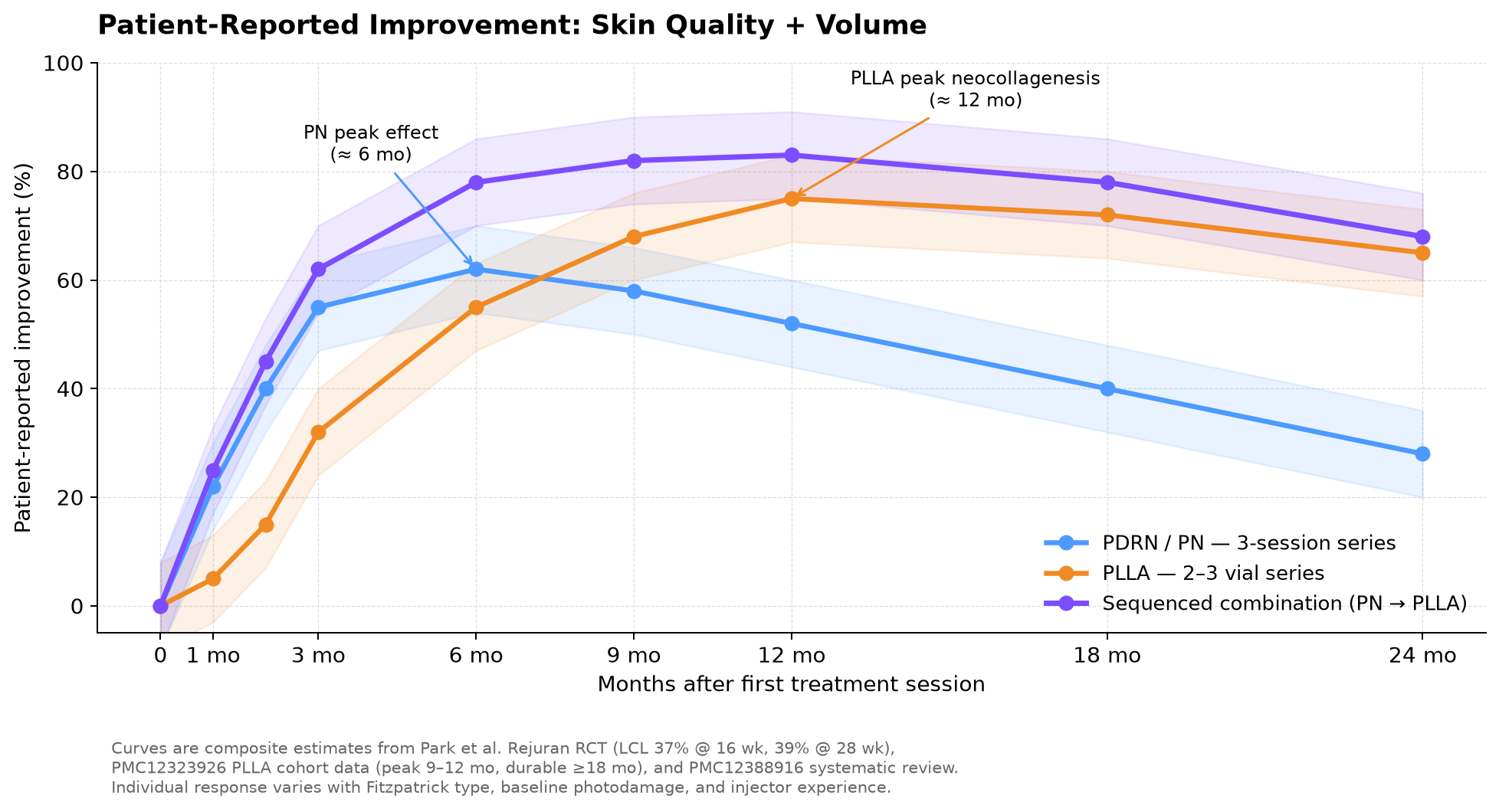
In a randomized split-face trial in the periocular region, PN outperformed non-crosslinked HA on skin roughness, pore size, and hydration. Lateral canthal line score improved 37% at 16 weeks and held at 39% at 28 weeks. There were zero adverse events across 27 subjects (Park KY et al., Korean Dermatology Society). That is a small trial, and I'd caution against reading it as definitive. But it is the cleanest head-to-head signal currently available for thin periocular skin.
PLLA — the collagen-inducing scaffold
Poly-L-lactic acid is a synthetic, bioresorbable polymer delivered as microparticles in a reconstituted suspension. It works through a fundamentally different mechanism: a controlled foreign-body response. The particles trigger a low-grade inflammatory reaction that recruits macrophages and fibroblasts, which lay down new Type I collagen around the particles as they degrade over 18–24+ months (PLLA advances review, PMC).
PLLA is the only agent in this trio that reliably restores structural volume. You are not filling a defect — you are asking the patient's body to build the fill over months. That single biological fact drives every protocol decision that follows: the dilution, the depth, the massage, the follow-up cadence, and the consultation script.
2. The Product Comparison — The Injector's Quick Reference
Print this and tape it inside the injectable prep room. Nearly every avoidable error in this category traces back to a line in this table.
| Attribute | PDRN | PN long-chain (Rejuran) | PLLA (Sculptra) |
|---|---|---|---|
| Category | Regenerative signal | Regenerative scaffold + signal | Collagen biostimulator |
| Source | Salmon DNA, 50–2,000 bp | Salmon long-chain DNA polymers | Synthetic bioresorbable polymer |
| Primary indication | Skin quality, hydration, post-procedure recovery | Texture, atrophic scars, periocular, thin skin | Midface/temple/jawline volumization, structural laxity |
| Injection plane | Intradermal (papillary/reticular junction) | Intradermal / superficial subdermal | Deep subQ / supraperiosteal — never dermal |
| Needle / cannula | 30–32G needle, nappage | 30–32G needle | 25–27G needle or 25G cannula |
| Volume per session (face) | 2–5 mL | 1–3 mL | 1–2 vials × 9 mL each |
| Reconstitution | Single-use ampoule | Single-use ampoule | 8 mL sterile water + 1 mL 2% lidocaine; shake 60 sec, use immediately |
| Sessions | 3 × at 2–4 wk intervals | 3 × at 3–4 wk intervals | 2–3 × at 4–6 wk intervals |
| Onset of visible effect | 2–4 weeks | 3–6 weeks | 6–12 weeks |
| Peak effect | 8–12 weeks | 4–6 months | 9–12 months |
| Duration | 6–9 months | 6–12 months | 18–24+ months |
| Modern AE profile | Erythema 12%, papules <5%, nodule <0.3% | Similar to PDRN; nodule risk minimal | Nodule 0.4–1.2% (8–9 mL + 5-5-5) |
| Reversible? | No (self-degrades in weeks) | No (self-degrades in months) | No — hyaluronidase does not work |
| Post-tx aftercare | SPF, gentle skincare | SPF, gentle skincare | 5-5-5 massage — mandatory |
| Cost (Central FL, 2026) | $350–$500 / session | $500–$800 / session | $900–$1,200 / vial |
Two rows in that table cause most of the trouble.
The reversibility row is the one to put in your consent form verbatim. Patients — and, in my experience, a nontrivial number of injectors — carry over a mental model from HA fillers where a bad result is dissolvable. It is not. Hyaluronidase does not dissolve PLLA, PN, or PDRN. Correction of over-injection requires steroids, saline, 5-fluorouracil, or in rare cases surgical excision, and it takes months.
The reconstitution row is the one that changed most recently. If your injectors are still hydrating vials the night before, they're following a protocol that the 2024 safety data has superseded.
3. Depth and Placement: The Strongest Safety Lever You Have
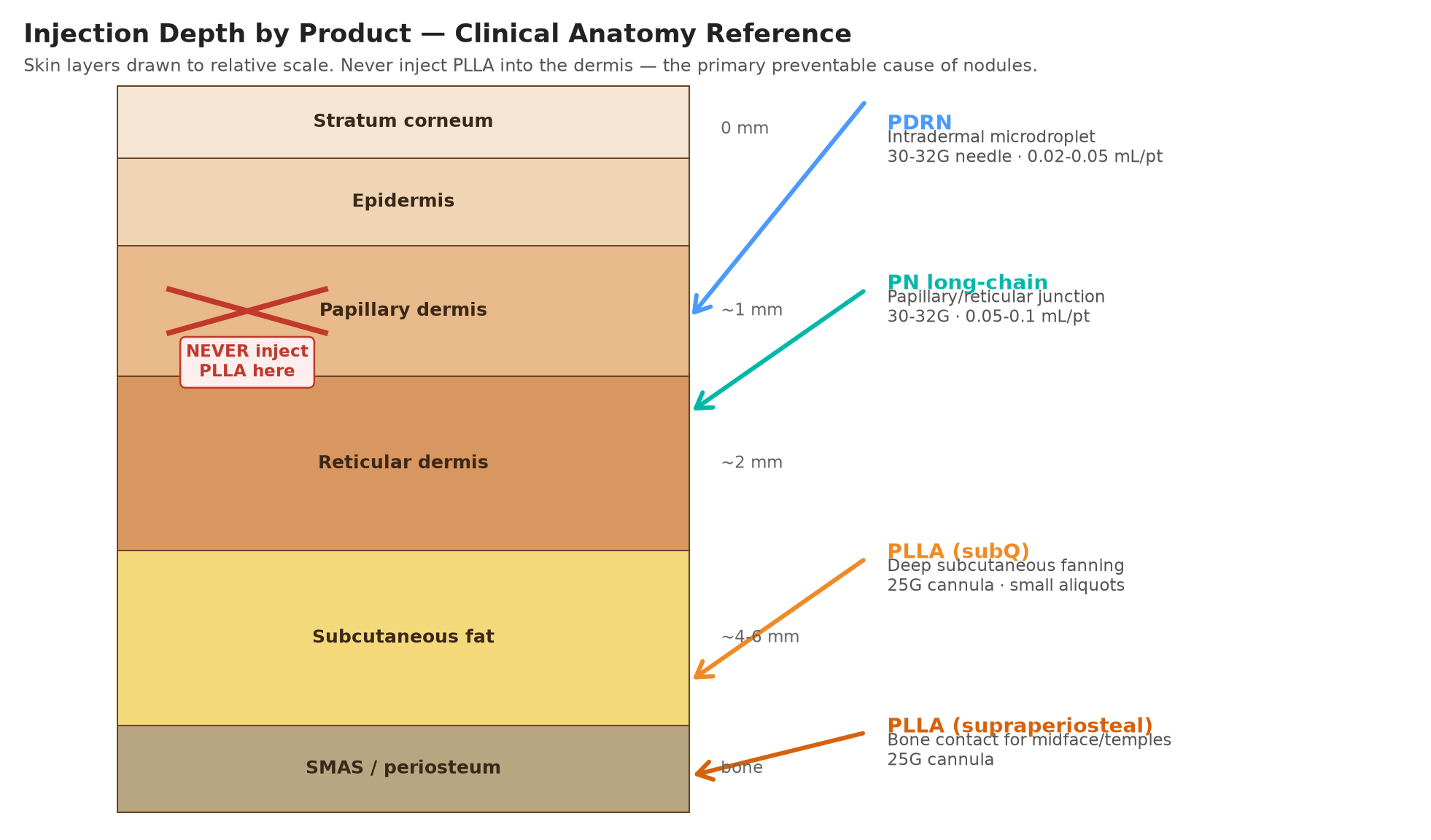
Depth choice is the single strongest technique lever for safety in this category. PDRN and PN belong in the dermis. PLLA belongs in the deep subcutaneous fat or on periosteum. Superficial PLLA is the most avoidable cause of nodules (MDedge on preventing Sculptra nodules and papules).
The rule of thumb I teach every new injector: if you can see the tip of a PLLA needle through the skin, you are too shallow. Withdraw, redirect, and go deeper. That one habit avoids most late nodules, and it costs nothing to adopt.
The mirror-image rule applies to PDRN and PN. Deposit just deep enough that you see a small papule form, but not so deep you feel the tissue "give." If a papule persists beyond 20 minutes post-injection, you went too shallow. That's a real-time feedback signal most injectors never get taught to read.
For medical directors: depth is the variable I'd audit first in any injector whose complication rate is drifting. It is more predictive than product choice, more predictive than volume, and — unlike either — it's directly observable if you supervise a few cases.
4. The Timeline Problem: Why Good Results Still Generate Complaints
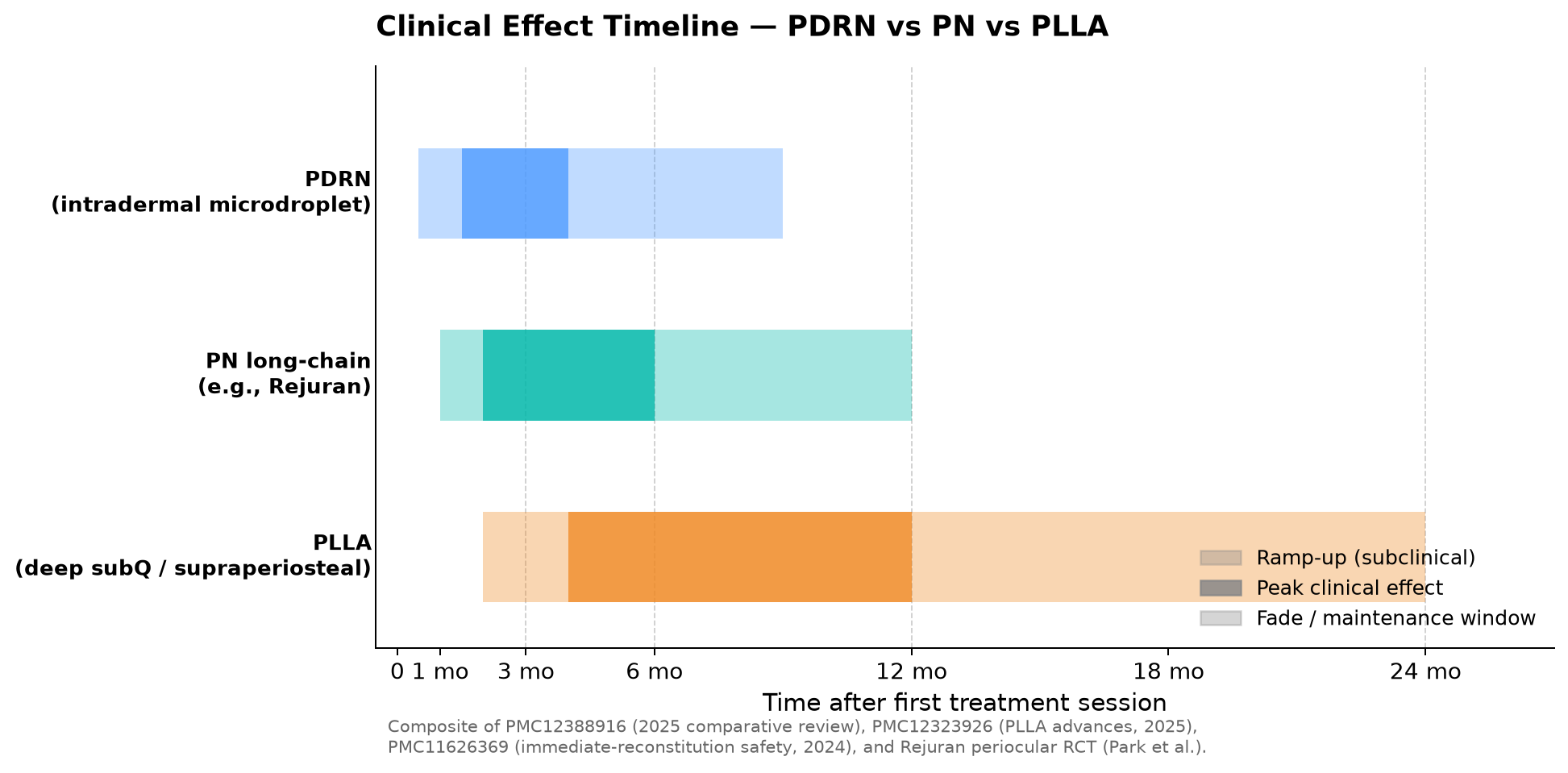
The single most common cause of patient dissatisfaction with these agents is not a bad result. It's a mismatched timeline expectation. If the patient thinks they bought a filler, they will walk out disappointed from a technically perfect injection.
Here is the shape of it, synthesized from the comparative review, the PLLA advances data, the immediate-reconstitution cohort, and the periocular PN trial:
| Agent | First visible change | Peak | Durability |
|---|---|---|---|
| PDRN | 2–4 weeks | 8–12 weeks | 6–9 months |
| PN long-chain | 3–6 weeks | 4–6 months | 6–12 months |
| PLLA | 6–12 weeks | 9–12 months | 18–24+ months |
PDRN gives you the fastest visible win — noticeable improvement at three to four weeks. PLLA gives you the most durable structural change but demands patience through what I've come to call the did-anything-happen valley: roughly weeks 6 through 12, when the inflammatory phase has settled, collagen deposition is underway, and the patient can see absolutely nothing.
Patients counseled about that valley almost never complain about it. Patients who aren't, always do. The intervention is not clinical, it's conversational: have the patient read the timeline out loud at the consult. It sounds patronizing. It heads off roughly 80% of downstream complaints in my experience, and it costs ninety seconds.
5. The Five-Step Clinical Protocol
This is the operational spine. Every case, every injector, every visit.
Step 1 — Structured assessment and expectation-setting
Before you pick up a needle, the case is already won or lost at intake.
- Standardized photography. Front, ¾ L, ¾ R, profile L, profile R. Same lighting, distance, head position. Non-negotiable.
- Baseline scoring. Glogau, Fitzpatrick, GAIS two weeks pre-procedure. For PN cases, add a Lateral Canthal Line score.
- Volume vs. quality mapping. Two questions: where do you see wrinkles or texture you don't like, and where do you see hollow or loose areas? Draw both on the intake form. They are different problems with different answers.
- Contraindication screen. Pregnancy, active infection, autoimmune flare within 3 months, isotretinoin within 6 months, anticoagulation, keloid history, fish/salmon allergy (PDRN/PN), dental procedure within 2 weeks.
- Timeline reality check. See Section 4.
Step 2 — Product selection and sequencing
Match agent to biology, not to what's on promo this month. The decision tree:
- Skin quality dominant, no significant volume loss → PDRN or PN monotherapy series.
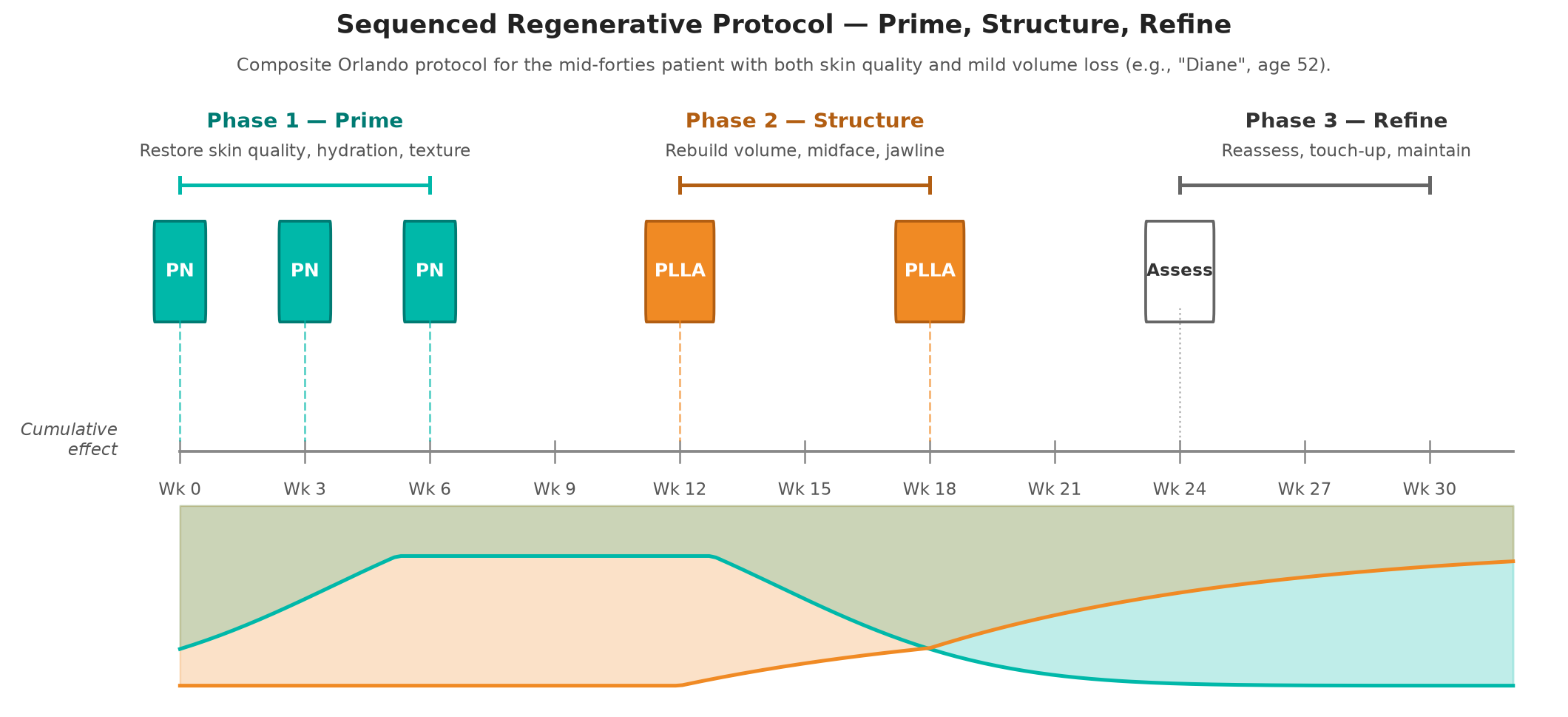
- Texture/quality plus mild-to-moderate volume loss → PN first (2–3 sessions), then PLLA starting 4–6 weeks after the last PN session.
- Volume loss and structural laxity dominate, skin quality acceptable → PLLA monotherapy.
- Prior filler complications or biofilm history → conservative PLLA only, deeper plane, half-dose first session, ultrasound at week 6.
Step 3 — Preparation and dosing
PDRN / PN per session. Total volume 2–5 mL across face and neck. Per point: 0.02–0.05 mL for PDRN, 0.05–0.1 mL for PN long-chain. Spacing on a 5–10 mm grid or nappage. Course of three sessions at 2–4 week intervals.
PLLA reconstitution (2026 standard). Face: 8 mL sterile water + 1 mL 2% lidocaine = 9 mL per vial. Neck and décolletage: 16–17 mL total including 1 mL lidocaine. Body: 17–20 mL total. Shake vigorously for 60 seconds — immediate reconstitution is now validated (Casabona et al., PMC). Warm to body temperature, agitate gently before each aspiration. Session cap of 1–2 vials for new injectors; experienced injectors may go to three.
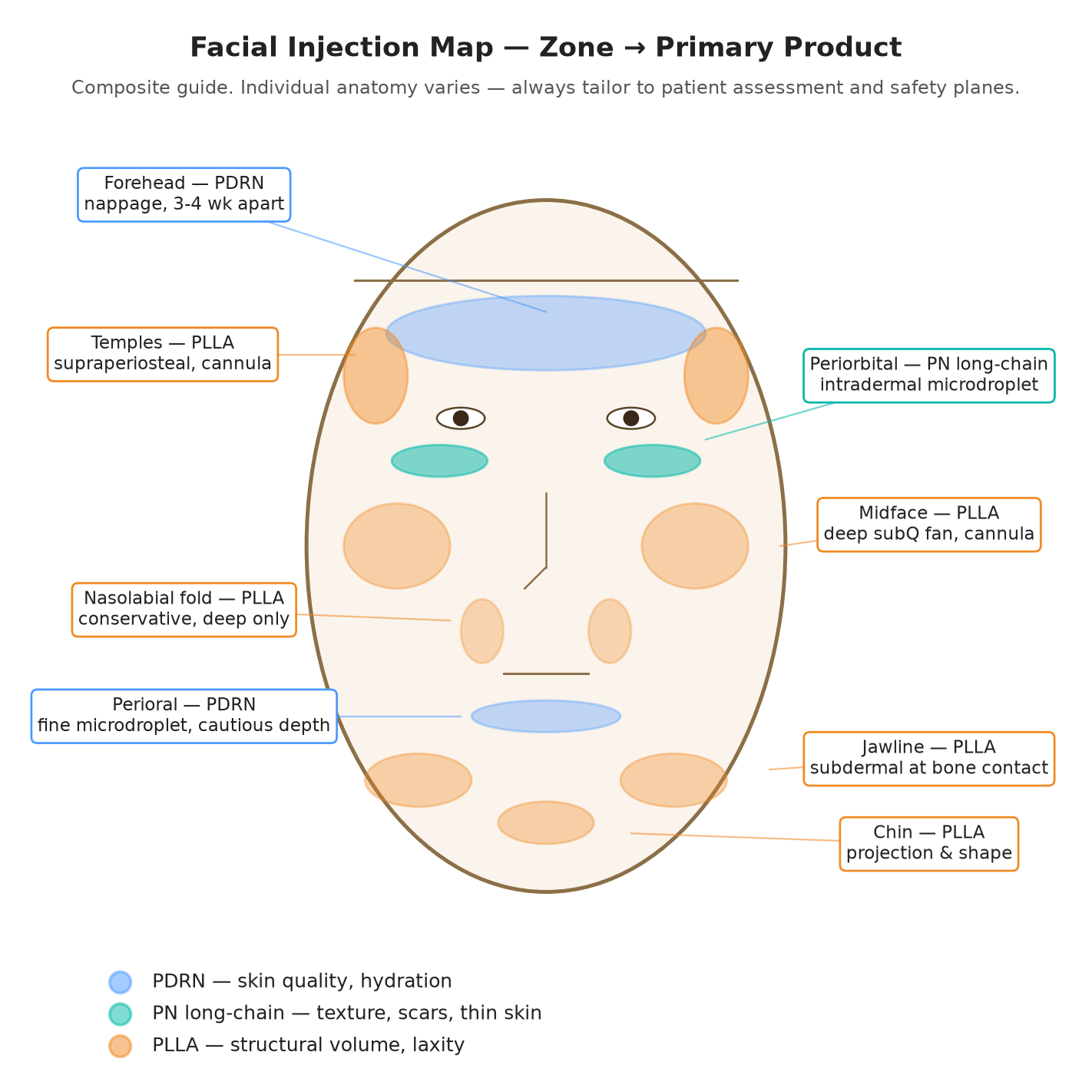
Step 4 — Injection technique
For PDRN and PN: 30–32G needle, perpendicular entry, nappage or microdroplet technique, with the 20-minute papule rule from Section 3 as your depth check.
For PLLA, six rules avoid nearly every nodule:
- Aspirate before every deposit if using a needle in temporal, glabellar, or perioral vasculature.
- Deep subcutaneous or supraperiosteal only.
- Fan-pattern threading with a 25G cannula for midface and jawline — less bleeding, lower vascular risk, more even distribution.
- Small aliquots of 0.1–0.2 mL along vectors. No bolus. Never inject a full mL in one spot.
- Avoid the masseter belly. Movement over active muscle coalesces product into palpable masses. Stay along the mandibular border.
- In-clinic molding: vigorous five-minute massage immediately post-injection, over each injected zone.
Step 5 — Aftercare, follow-up, and complication surveillance
48-hour text check-in from the front desk with a photo and symptom check. Two-week photo review to catch superficial papules early. Six-week in-office review to reassess volume response and plan the next session. Three-month standardized photography plus GAIS scoring — this is when PLLA effects become undeniable. Twelve-month full re-evaluation to set the maintenance cadence.
And then the highest-yield instruction in this entire guide:
The 5-5-5 protocol. Five minutes of firm circular massage, five times per day, for five days. Clinics that standardize this into a written handout and have the patient demonstrate the technique before leaving see nodule rates below 1%. Clinics that mention it verbally at checkout and hope? Multiples higher. The delta between those two clinics is a piece of paper.
6. Three Composite Cases: Maria, Diane, and Robert
These are composite presentations assembled from typical Central Florida panel patterns — not individual patients, and not case reports. Outcomes described are representative of what the protocol is designed to produce, not measured results from a specific person.
Case 1 — Maria, 34: PN monotherapy for post-acne texture
Personal trainer, Fitzpatrick III, acne cleared eight years ago. Presents with icepick and rolling scars and mild pore dilation. No volume loss. Her framing: "I don't want filler. I want my skin to look like it did in college."
Why not PDRN? It would help hydration and barrier function but wouldn't address a physical texture defect. Why not PLLA? PLLA is a volumizer. Injecting it into a 34-year-old with normal volume creates exactly the puffy look she's trying to avoid.
Protocol: PN long-chain, 1 mL divided into 0.05 mL microdroplets at 8 mm spacing across both cheeks, three sessions three weeks apart. Superficial microneedling immediately before the session-2 deposit to enhance penetration into atrophic scars. Reassess at 12 weeks; consider one maintenance session at month 6. Representative cost, roughly $1,800.
Teaching point — Maria: do not over-inject young patients with intact volume. Regenerative agents are pull-through revenue, not upsell theater. The 34-year-old you don't over-inject is the 44-year-old who still trusts you.
Case 2 — Diane, 52: sequenced PN → PLLA
Real estate agent, Fitzpatrick II, considerable Florida sun damage. Midface deflation, crepey neck, periorbital lines. Two syringes of HA in the tear troughs two years ago with a good result and no complications. Her framing: "I want to look rested, not done."
Why sequence rather than combine same-day? Two reasons. First, PN needs three to four weeks to demonstrate baseline dermal quality improvement, and that response tells you how much PLLA the tissue actually needs. Second, if a complication appears, you want to know which product caused it. Same-day combination trades clarity about which product caused it for scheduling convenience, and you inherit that trade at the worst possible moment.
Timeline: PN 1 mL to face plus PDRN 2 mL to neck and décolletage at weeks 0, 3, and 6. Week 10 photo review and consent for the PLLA phase. Week 12, two vials at 9 mL, cannula fan pattern into midface (deep subQ), temples (supraperiosteal), and jawline (subdermal at the mandibular border), with in-clinic molding and a written 5-5-5 handout demonstrated on her own face before she leaves.
Week 18, 1.5 vials for residual midface flattening and jawline definition. Week 26 review with the explicit expectation that full effect is another three to six months out. Peak around month 9. Representative cost across five sessions, roughly $5,400.
Teaching point — Diane: sequencing works because biology unfolds in stages. Compressing a sequenced protocol into a single visit trades safety for convenience — the patient never gets the outcome, and you inherit the complication risk.
Case 3 — Robert, 61: cautious PLLA-only with ultrasound
Semi-retired attorney, Fitzpatrick II. Moderate volume loss with mild laxity. Two years ago at another clinic he received cheek HA, developed two small nodules at four months, resolved with hyaluronidase — and the experience left him wary. He has read forum threads about PLLA granulomas and has explicitly asked for ultrasound imaging. His framing: "Show me the least invasive thing that will actually work."
Why still consider PLLA? His volume loss is real and progressing. HA is off the table psychologically. PN alone will not address the volume component. He needs a version of the PLLA protocol calibrated to his risk profile, not a different product.
Conservative modifications: dilution at the upper end, 9 mL per vial minimum, no compromise. Half-dose first session — one vial only, across midface and temples. Deep supraperiosteal placement only, 25G cannula, no subdermal work in session 1. Point-of-care ultrasound at week 6 to confirm distribution and rule out early collection formation, now reasonable standard of care in high-risk patients. Documented massage compliance. Extra follow-ups at weeks 2, 4, 6, and 8.
Teaching point — Robert: anxious patients are not bad patients. They are patients who require better protocols, more communication, and technique adjustments — and they often become the most loyal in the panel. Turning them away leaves both outcomes and revenue on the table.
7. Adverse Events: The Honest Numbers
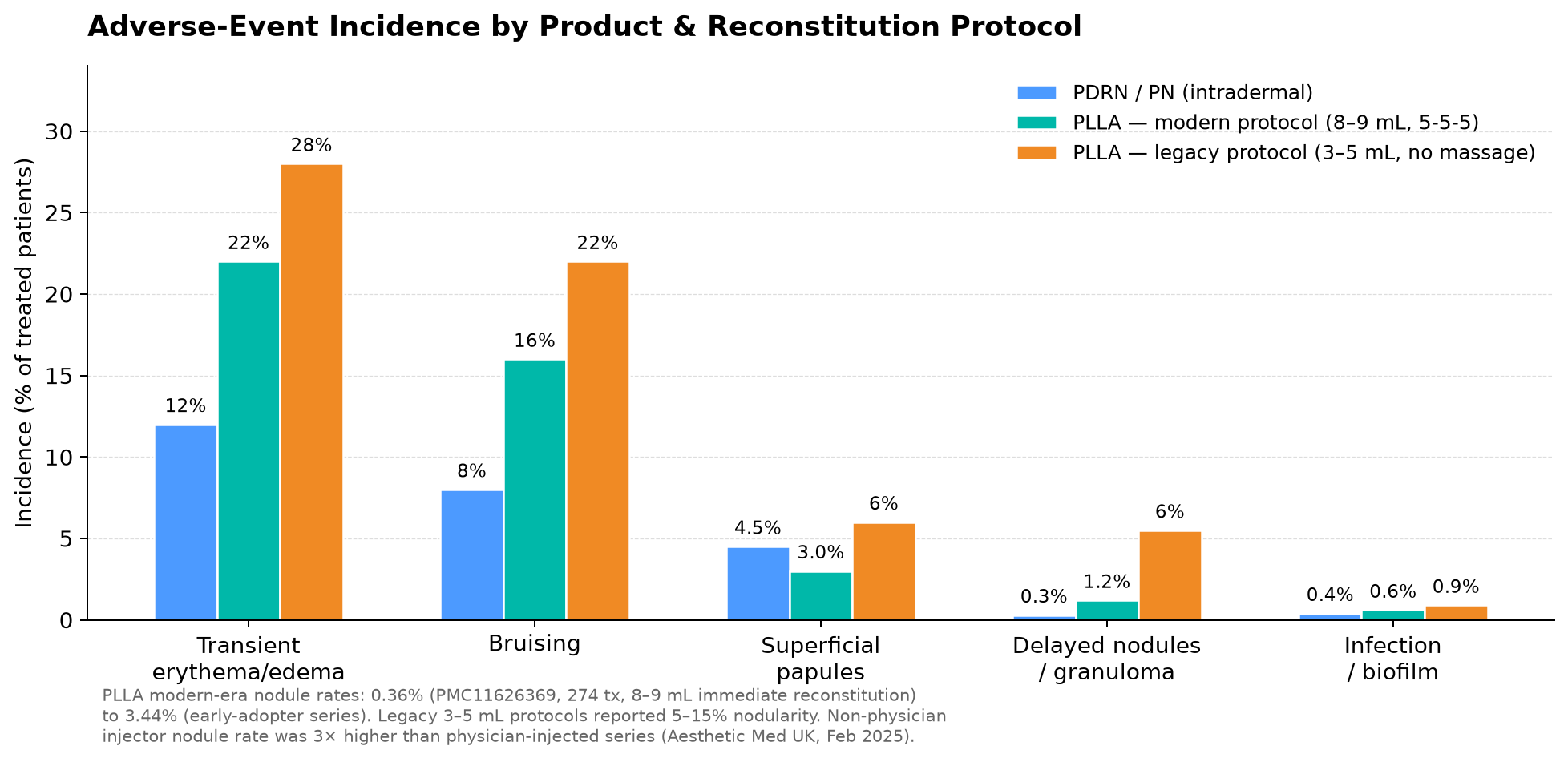
The adverse event conversation is where clinics get either evasive or apocalyptic. The truth sits between the two extremes, and it depends almost entirely on which era's protocol you follow.
| Protocol era | PLLA dilution | Massage | Placement | Nodule rate |
|---|---|---|---|---|
| Legacy (pre-2020) | 3–5 mL | Ad hoc / verbal | Often subdermal | ~5–15% |
| Modern (2024–2026) | 8–9 mL | Documented 5-5-5 | Deep subQ / supraperiosteal | ≤1.2% |
That reduction did not come from a reformulated product. Sculptra is largely unchanged. It came from technique standardization — which means it is fully available to any clinic willing to rewrite its SOP this week.
For PDRN and PN, the modern profile is mild: erythema around 12%, papules under 5%, nodules under 0.3%, and the periocular PN trial reported zero adverse events across 27 subjects. The dominant PN complication is a superficial papule from injecting too shallowly, which is a technique error with a 20-minute feedback loop.
For medical directors: the injector-level finding from the 2025 UK consensus — roughly 3× higher nodule rates among non-physician injectors — is not an argument for restricting scope. It's an argument for supervised case minimums before independent PLLA practice. Twenty supervised cases is the threshold I use.
8. The Complication Playbook
| Event | Timeframe | First-line | Second-line | Refer when |
|---|---|---|---|---|
| Erythema / edema | 0–72 hr | Cold compress, reassure | Topical steroid if severe | Persists >2 wk |
| Bruising | 0–2 wk | Arnica, cold compress | Vascular laser if severe | Associated with pain |
| Superficial PN papule | 0–2 wk | Warm compress, massage | Low-dose intralesional steroid | Rare |
| PLLA soft firmness | 2–8 wk | Aggressive massage, warm compress | Intralesional saline 0.5–1 mL | Firm >6 wk |
| PLLA inflammatory nodule | 6 wk – 12 mo | IL triamcinolone 10 mg/mL, 0.1–0.3 mL/lesion q4wk | Add 5-FU (50 mg/mL) 1:4 with steroid | Refractory ≥3 injections |
| PLLA granuloma | 6–24 mo | Ultrasound + biopsy | IL steroid + 5-FU; oral doxycycline if biofilm | Surgical excision as last resort |
| Infection | Any | Culture + empiric antibiotic (cephalexin 500 mg QID) | Prolonged doxycycline for biofilm | Abscess → I&D |
| Vascular compromise | Immediate | Stop, warm compress, aspirin 325 mg PO, nitroglycerin paste | Emergency vascular referral | Vision change → ophthalmology stat |
| Anaphylaxis | Immediate | Epinephrine 0.3 mg IM, 911 | High-flow O2, observe biphasic | Emergency room |
Three notes from the clinic floor:
Hyaluronidase does not dissolve PLLA. It can improve tissue permeability adjacent to a PLLA nodule, and some clinicians use it in that context. But do not counsel a patient that PLLA is reversible the way HA is. It is not, and that conversation goes very badly at month four.
Ultrasound is your friend. Point-of-care ultrasound distinguishes a soft-tissue collection (drainable, culture-worthy) from a fibrotic nodule (steroid-worthy) from a granuloma (steroid plus 5-FU worthy). Every clinic doing PLLA at volume should have portable ultrasound access or a referral partnership that does. Without it, you are managing nodules by category rather than by pathology.
Biofilms present as allergic-looking nodules with negative cultures. If you see a delayed inflammatory nodule that fluctuates and refuses to resolve, add oral doxycycline 100 mg BID for six to eight weeks alongside intralesional steroid. The culture will often be negative because biofilm organisms don't grow on routine plates — a negative culture is not reassurance here.
9. Business and Operational Realities
The regenerative service line does not price like traditional filler. HA fillers pay off in one visit. Regenerative agents pay off across a three-to-six session arc. Package pricing is not a discount strategy — it's the mechanism that aligns patient expectations with clinical biology.
| Package | Contents | Retail (Central FL, 2026) | Deposit |
|---|---|---|---|
| Skin Foundation | 3 PN or PDRN sessions | $1,500 – $2,100 | 33% |
| Neck & Décolletage Restore | 3 PDRN sessions, face + décolletage | $1,800 – $2,400 | 33% |
| Full Rejuvenation Arc | 3 PN sessions + 2 PLLA sessions | $4,500 – $5,900 | 25% |
| Structural Volume | 3 PLLA sessions | $2,700 – $3,600 | 25% |
| Annual Maintenance | 2 PN + 1 PLLA booster | $2,000 – $2,600 | Auto-charge |
Inventory. PLLA runs $400–$550 wholesale per vial in 2026 with a 24-month pre-reconstitution shelf life. Immediate-reconstitution protocols eliminate the old waste-from-batch-prep problem — reconstitute at the point of care. PDRN and PN ampoules are single-use; keep a rolling 30-day supply based on your booking pipeline, not on manufacturer minimums. Track expiration to the day.
The complication registry. Every clinic doing regenerative injectables at volume should maintain an internal registry. A shared spreadsheet is sufficient. Capture date, injector, product, lot, volume, AE type, onset, resolution time, and intervention required. Audit quarterly against your SOP targets — PLLA nodules under 1%, infection under 0.5%, photo completion at 100%, six-week rebook rate at or above 70%.
Clinics that do this consistently identify technique drift months before it becomes a reputation issue. Clinics that don't find out from a Google review.
10. Medical-Marketing Compliance: LegitScript, Google, and Meta
This is the section I get asked about most by clinic owners, and I'll be direct: the compliance line in regenerative aesthetics is drawn around mechanism and timeline claims are fine, outcome guarantees are not. Almost every ad rejection I've reviewed violates that one principle.
[REGENERATIVE INJECTABLE AD COMPLIANCE — GO/NO-GO]
☐ DO NOT CLAIM
   - "Reverses aging" / "turns back the clock"
   - "Look 10 years younger" (specific quantified outcome)
   - "Guaranteed" results, or guaranteed absence of nodules
   - "Permanent" — PLLA is durable, not permanent
   - Any comparison implying superiority over a named competitor
     product without head-to-head evidence
☐ SAFE TO CLAIM
   - Biologic mechanism (collagen stimulation, A2A signaling)
   - Gradual improvement over a stated timeframe
   - Session counts and typical course length
   - Durability windows sourced to published literature
   - "Physician-led" / "board-certified" if literally true
☐ BEFORE/AFTER PHOTOS — ALL FOUR REQUIRED
   - Explicit signed consent naming the platforms used
   - Unmodified images (no filters, no retouching, no lighting change)
   - Disclosed session count
   - Disclosed timeframe between photos
☐ LANDING PAGE MUST INCLUDE
   - The same timeline expectations shown at consult
   - Explicit statement that results vary
   - Statement that candidacy requires individual evaluation
If any box is unchecked → do not launch.
The reason to put the timeline on the landing page is not compliance theater. It pre-sets expectations before the consult, which measurably reduces the did-anything-happen-valley complaints described in Section 4. Compliance and conversion happen to point the same direction here, which is rarer than it should be.
11. The Eight-Item Audit Checklist
If you're operating a clinic today on a "we've been doing it this way for years" regenerative protocol, these are the eight things to audit against 2024–2026 evidence. Consolidated for standalone use:
[REGENERATIVE INJECTABLES — EIGHT-ITEM PROTOCOL AUDIT]
☐ 1. PLLA DILUTION
     Are you at 8–9 mL per facial vial? If less, update tonight.
☐ 2. IMMEDIATE RECONSTITUTION
     Do injectors know it's validated (Casabona 2024)?
     Overnight hydration is no longer required.
☐ 3. THE 5-5-5 HANDOUT
     Written, demonstrated, and signed — or verbally
     mentioned at checkout?
☐ 4. SEQUENCING DEFAULT
     Is "PN first, PLLA second" the default pathway, or are
     injectors combining same-day for scheduling convenience?
☐ 5. STANDARDIZED PHOTOGRAPHY
     Fixed setup, mandatory capture every visit — or the
     injector's phone when they remember?
☐ 6. CONSENT LANGUAGE
     Does consent explicitly state "hyaluronidase does not
     dissolve PLLA"?
☐ 7. ULTRASOUND ACCESS
     Point-of-care unit or referral relationship? Without one
     you cannot work up a nodule properly.
☐ 8. COMPLICATION REGISTRY
     One owner, audited quarterly, rolling 12-month view?
These eight fixes cost almost nothing. They are the difference between a 0.5% nodule rate and a 5% nodule rate.
12. Where the Evidence Still Has Gaps
Intellectual honesty matters more in this category than in most, because the marketing runs well ahead of the literature.
- Head-to-head RCTs between PDRN and PN long-chain are limited. Most comparative data comes from case series and split-face designs. The 2025 comparative review is the best current synthesis and calls out this gap explicitly (Kim et al., PMC).
- PDRN evidence is described by its own systematic reviewers as embryonic. Across 16 trials and roughly 750 participants, the 2024 review concluded that standardized sequencing, molecular weight reporting, and dosing regimens remain unsettled (Ceccarelli et al., EJPS). Read that alongside the enthusiastic product marketing and calibrate accordingly.
- PLLA long-term durability data extends to roughly 24 months in most series. Genuine five-year data remains sparse, including for body applications (international body consensus, PMC).
- Combination protocols lack RCT-level evidence. PN plus PLLA plus microneedling plus energy devices is driven by case series and expert consensus, not trials. Active work is ongoing — for example, a registered trial of PDRN for periocular wrinkles (ClinicalTrials.gov NCT07280637) — but the combination question is largely unstudied.
If you sequence, document your outcomes. The field genuinely needs the data, and the clinics running these protocols at volume are the ones positioned to generate it.
13. Conclusion
Regenerative injectables reward the teams that regard biology as a partner rather than a marketing category. Maria, Diane, and Robert are composites, but they are composites of the panel walking through a Central Florida aesthetic clinic every week — the young patient who needs less than she'll be offered, the mid-fifties patient who needs a sequence rather than a session, and the anxious patient who needs a protocol rather than a rejection.
The five-step protocol works because it forces the same discipline in every case: assess before selecting, sequence before combining, dilute properly, place deeply, massage seriously, and follow up on a schedule. None of that is proprietary. All of it is auditable this week.
Run the eight-item audit in Section 11. Adopt the SOP and consent templates in the PDF. Print the timeline table for your consult rooms. Track outcomes and complications quarterly. The patients get better results, the team gets fewer late-night worry calls, and you get a service line that compounds — clinically, operationally, and reputationally — year over year.
14. References
Primary comparative source: Kim et al. — "Comparison of Polynucleotide and Polydeoxyribonucleotide in Aesthetic Medicine" (PMC, 2025). The clearest current synthesis separating PDRN from long-chain PN on mechanism and indication.
Additional peer-reviewed and industry sources:
- Ceccarelli et al. — "Points to ponder on the role of polynucleotides in regenerative and aesthetic medicine: a systematic review" (European Journal of Plastic Surgery, 2024). Systematic review of 16 PDRN trials; source of the "embryonic stage" assessment.
- Casabona et al. — "Safety of the Immediate Reconstitution of Poly-L-Lactic Acid" (PMC, 2024). The 0.36% nodule rate across 274 treatments that retired the overnight-hydration requirement.
- PMC — "Advances in Poly-L-Lactic Acid Injections for Facial and Neck Rejuvenation" (2025). PLLA mechanism, peak-effect window, and durability data.
- PMC — "Injectable Poly-L-Lactic Acid for Body Aesthetic Treatments: An International Consensus" (2024). Body dilution standards and the long-term data gap.
- Park KY et al. — "Efficacy and safety of a polynucleotide filler in periorbital wrinkles" (Korean Dermatology Society). Split-face periocular RCT; 37% LCL improvement at 16 weeks, 39% at 28 weeks, zero AEs across 27 subjects.
- Aesthetic Medicine UK — "Polylactic Acid" consensus review (February 2025). Source of the dilution-risk relationship and the 3× injector-type nodule differential.
- MDedge — "Tips for Preventing Nodules and Papules with Sculptra". Practical placement guidance underlying the depth rules in Section 3.
- Ninaveli Knowledge Hub — "Deep Dermal Bioremodeling: How Polynucleotides Activate A2A Receptors" (2026). Mechanistic overview of the A2A/cAMP/PKA cascade.
- Skincareful — "PDRN in Skincare: The Clinical Science Behind Regenerative Repair" (2026). Industry synthesis of PDRN collagen-synthesis figures.
- ClinicalTrials.gov — NCT07280637, "Regenerative Treatment of Periocular Wrinkles With PDRN". Registered trial addressing part of the periocular evidence gap.
This article was written and medically reviewed by Kenny Chantasi, DO, and checked against publicly available peer-reviewed literature as of August 8, 2026. It is written for clinicians and clinic operators. Nothing in it is medical, legal, or regulatory advice, and it is not a substitute for state-specific licensure, scope-of-practice, or physician supervision requirements. Verify all dosing, dilutions, and indications against current product labeling and your medical director before clinical use. Patients Maria, Diane, and Robert are composite illustrations, not identifiable individuals.
Prefer the PDF version? Download the full 34-page field guide →
Kenny Chantasi, DO is board-certified in physical medicine and rehabilitation with subspecialty certification in pain medicine (NPI 1427216175; Florida osteopathic license OS22127). He practices regenerative and interventional medicine at PrimeCell Regenerative & Aesthetic Medicine in Orlando, Florida, caring for patients with musculoskeletal pain, joint degeneration, and neuropathy. He authors and medically reviews the clinical content published here. Articles are educational and are not a substitute for individual medical advice; no outcome is guaranteed.
Appendices
The three templates below are the operational artifacts referenced throughout this guide. They are provided for internal clinic adaptation.
Appendix A — Injector SOP (PDRN / PN / PLLA)
Standard Operating Procedure — Regenerative Injectables Service Line. Version 1.0. Owner: Medical Director. Review cadence: quarterly.
1. Scope and staff roles
| Role | Authority |
|---|---|
| Medical Director (MD/DO) | Protocol owner, complication management, PLLA supervision for new injectors (first 20 cases) |
| Nurse Injector (RN/NP/PA) | Independent PN/PDRN once ≥10 supervised cases; independent PLLA once ≥20 supervised cases |
| Aesthetician | Consult intake, aftercare education, photography — no injection |
| Front Desk | Scheduling, consent verification, product lot logging |
2. Pre-procedure checklist (every patient, every visit)
- Confirm consent signed within 12 months (re-sign if lapsed)
- Screen for new medications, dental work in past 2 weeks, active infections
- Standardized photography — front, ¾ L, ¾ R, profile L, profile R (Canfield/Vectra if available)
- Review previous injection map and lot numbers
- Confirm no isotretinoin in past 6 months
- Confirm not pregnant / breastfeeding (verbal + written)
- Confirm no autoimmune flare in past 3 months
- Set expectations: onset, sessions, cost, timeline
3. Product handling
PDRN / PN (Plinest, Newest, Rejuran)
- Store at 2–25°C unless manufacturer states otherwise
- Single-use ampoules — never admix with other products
- Draw immediately before use; discard within 60 min of opening
PLLA (Sculptra Aesthetic)
- Facial reconstitution: 8 mL sterile water + 1 mL 2% lidocaine = 9 mL total per vial
- Body / neck / décolletage: 16–17 mL sterile water + 1 mL 2% lidocaine
- Immediate reconstitution is validated (PMC11626369, 2024) — shake vigorously 60 seconds; no mandatory rest period
- Warm to body temperature before injection
- Gentle agitation immediately before each aspiration to avoid settling
- Log lot # and reconstitution timestamp on chart
4. Injection technique — quick reference
| Product | Depth | Needle / cannula | Volume per point | Spacing |
|---|---|---|---|---|
| PDRN | Papillary → reticular junction | 30–32G needle, nappage | 0.02–0.05 mL | 5–10 mm |
| PN long-chain | Intradermal / superficial subdermal | 30–32G needle | 0.05–0.1 mL | 8–10 mm |
| PLLA — midface | Deep subQ / supraperiosteal | 25–27G needle or 25G cannula | Small aliquots — no bolus | Fan pattern |
| PLLA — temples | Supraperiosteal only | 25G cannula preferred | 0.1–0.2 mL/pass | Radial fan |
| PLLA — jawline | Subdermal at bone contact | 25G cannula | Linear threading | Along mandibular border |
Absolute rules.
Never inject PLLA superficially in the dermis.
Never inject PLLA over the masseter belly (movement clumps product).
Never exceed 2 vials per hemiface in a single session for new injectors.
Aspirate before every PLLA deposit if using a needle in high-vascular zones.
5. Immediate post-injection (in-clinic)
- Vigorous molding massage × 5 minutes for PLLA
- Cool compress
- Photograph result
- Provide aftercare handout + demo 5-5-5 massage on patient's own face
- Book 2-week check-in + 6-week review before patient leaves
6. Follow-up cadence
| Interval | Action |
|---|---|
| 48 hours | Text/call check-in (front desk) |
| 2 weeks | Photo review, symptom check |
| 6 weeks | In-office assessment, touch-up planning |
| 3 months | Standardized photos + GAIS scoring |
| 6 months | Post-series review; plan maintenance |
| 12 months | Full re-evaluation + photo comparison |
7. Complication escalation
Immediate (any injector may initiate):
- Severe pain / blanching / vascular signs → stop injection, warm compress, aspirin 325 mg PO, page MD stat, transfer to ophthalmology if periorbital
- Anaphylaxis → epinephrine IM 0.3 mg, 911
Early (0–7 days):
- Bruising, edema → arnica, cold compress, reassure
- Infection signs → oral antibiotic per antibiogram (cephalexin 500 mg QID default), culture if drainage
Delayed (>2 weeks):
- Soft firmness → aggressive massage, warm compress, reassess at 2 weeks
- Persistent nodule at 6 weeks → ultrasound imaging, intralesional saline (0.5–1 mL) + gentle massage
- Inflammatory nodule → intralesional triamcinolone 10 mg/mL, 0.1–0.3 mL per lesion, repeat q4wk
- Refractory nodule → add 5-FU (50 mg/mL) 1:4 with triamcinolone, or refer for excision
8. Documentation — every injection
| Field | Required |
|---|---|
| Product name | Yes |
| Lot number | Yes |
| Reconstitution volume + timestamp | Yes (PLLA) |
| Volume injected per region | Yes |
| Injection map | Yes |
| Immediate post-photos | Yes |
| Aftercare handout signed | Yes |
9. Quarterly audit (Medical Director)
- Complication rate per injector (target: PLLA nodules <1%, infection <0.5%)
- Photo completion rate (target: 100%)
- Massage-compliance survey score (target: ≥8/10)
- Rebook rate at 6 weeks (target: ≥70%)
- Chart random 10% for consent, lot, and injection-map completeness
Adopt, adapt, and version-control. This SOP references PMC11626369 (2024 immediate-reconstitution safety data), PMC12323926 (2025 PLLA advances), and the Aesthetic Medicine UK PLLA consensus (Feb 2025). Update quarterly as evidence evolves.
Appendix B — Informed consent template (PDRN / PN / PLLA)
Template for internal clinic use. Adapt to your state licensing requirements and physician oversight structure. Not legal advice.
Patient name ____________________ · DOB __________ · Date __________
Injector ____________________ · Physician of record ____________________
Products discussed today
- PDRN (polydeoxyribonucleotide) — e.g., Plinest®, Newest®
- PN long-chain polynucleotide — e.g., Rejuran® Healer
- PLLA (poly-L-lactic acid) — Sculptra® Aesthetic
- Combination therapy: __________________________
Purpose of procedure
I understand this is a regenerative aesthetic procedure intended to support skin quality, elasticity, texture, hydration, and/or facial volume through gradual biologic remodeling. I understand results are not immediate, and that these are not hyaluronic acid fillers.
Timeline of effect — I acknowledge
- PDRN / PN: onset 2–4 weeks, peak 8–12 weeks, duration 6–12 months, typical course 3 sessions at 2–4 week intervals.
- PLLA: onset 6–12 weeks, peak 9–12 months, duration 18–24+ months, typical course 2–3 sessions at 4–6 week intervals.
- Multiple sessions are required. A single session is unlikely to achieve the final result.
Reversibility — critical to understand
I understand that hyaluronidase does not dissolve PDRN, PN, or PLLA. Once injected, these products cannot be enzymatically reversed. Correction of over-injection or nodules requires steroids, saline, 5-fluorouracil, or in rare cases surgical excision — often taking months to resolve.
Common expected effects (24–72 hours)
Injection-site erythema, mild edema, tenderness, pinpoint bleeding, bruising, and transient palpable firmness. These typically resolve without intervention.
Less-common risks — I acknowledge
- PLLA delayed nodules or granulomas (0.4–3% with modern 8–9 mL dilution + 5-5-5 massage; higher with legacy protocols). May appear 1–12 months post-procedure.
- Superficial papules from PN/PDRN if injected too shallowly (usually self-resolving).
- Infection or biofilm (<1%) — may require prolonged antibiotics.
- Rare vascular events (blanching, pain, tissue compromise) — <0.1% with proper technique.
- Hypersensitivity reactions — rare; disclose fish/salmon allergy if PDRN or PN considered.
- Unexpected aesthetic result — asymmetry, undercorrection, or overcorrection may require additional sessions.
Aftercare — I commit to
- Perform the 5-5-5 massage post-PLLA: 5 minutes, 5 times daily, for 5 days.
- Avoid intense exercise, heat exposure, saunas, and facials for 48 hours.
- Avoid dental work for 2 weeks post-procedure.
- Use SPF 30+ daily.
- Report any lumps, firmness, prolonged redness, pain, blanching, or fever immediately.
Contraindications I have disclosed
- Pregnancy or breastfeeding
- Active infection, cold sore, or dermatitis at the injection site
- Autoimmune disease (lupus, scleroderma, sarcoidosis, RA) — flare status: __________
- History of keloids or hypertrophic scarring
- Bleeding disorder or current anticoagulation
- Prior filler complications: __________________________
- Fish / salmon allergy (relevant for PDRN, PN): __________
- Isotretinoin use in past 6 months
- Recent dental procedure (<2 weeks)
Product traceability
| Product | Lot # | Expiration | Volume (mL) | Reconstitution time |
|---|---|---|---|---|
I have read, understood, and had all questions answered. I consent to this procedure.
Patient signature ____________________________ · Date __________
Witness / Injector signature ____________________________ · Date __________
Appendix C — Patient aftercare handout (Sculptra® / PLLA)
Your procedure today
Poly-L-lactic acid (PLLA / Sculptra® Aesthetic) — a biostimulator that gradually rebuilds your own collagen over the next several months. This is not filler. The result develops slowly and peaks around month 9–12.
The 5-5-5 Massage Rule — the single most important thing you can do.
Starting today, for the next 5 days: 5 minutes of firm circular massage, 5 times per day, for 5 days.
Why it matters. Massage keeps the PLLA particles evenly distributed under the skin while they trigger new collagen. Skipping massage is the #1 cause of the small lumps we work hard to avoid. Clinics that standardize the 5-5-5 protocol report nodule rates below 1%.
How to massage. Firm circular motions over each injected area. Use a small amount of moisturizer or clean fingertips. Firm — not painful.
First 24 hours
- Expect swelling, redness, and possibly some bruising — this is normal
- Apply a cool compress for 10 minutes on / 10 minutes off (no direct ice)
- Sleep with your head slightly elevated
- Tylenol (acetaminophen) is fine for discomfort
- Avoid ibuprofen, aspirin, and alcohol for 24 hours (unless you're on daily aspirin per your MD)
First 48–72 hours — avoid
- Intense exercise, sweating, or hot yoga
- Saunas, steam rooms, hot tubs
- Facials, chemical peels, laser
- Makeup on injection points (day of procedure)
- Sleeping face-down or on the injected side
First 2 weeks
- Avoid dental procedures (schedule around your procedure)
- SPF 30+ every day
- Gentle skincare — no retinoids or exfoliants for 5–7 days
What "normal" looks like
You may feel firmness or small bumps that come and go in the first 2–4 weeks. This is the product working, and most of these settle on their own — especially if you massage. The visible result develops slowly over 6 to 12 weeks. Most patients see a subtle change by month 2 and a clear result by month 3–4, building to the peak effect around month 9–12.
Call us right away if you notice
- A hard lump that does not soften after a week of massage
- Severe pain, blanching (skin turning white), or blue/purple discoloration
- Fever, spreading redness, or drainage
- Any concern that feels different from "typical swelling"
Your follow-up schedule
- Check-in call/photo: Day 14
- In-office review: Week 6
- Next PLLA session (if planned): Week ______
- Long-term review + photos: Month 3 and Month 12
This handout accompanies your written consent and is not a substitute for medical advice.
Related services at PrimeCell
PrimeCell is a physician-led practice in Orlando. Candidacy for any procedure is determined at an in-person evaluation.
Ready when you are
Talk with a physician about your options
Have questions about whether this is right for you? Book a consultation with Dr. Chantasi, or call the clinic and we'll talk it through.
Orlando, FL · Mon–Fri 10am–6pm