
Industry Insights · Regulatory & Market Analysis
Stem Cells in 2026: A Fundamentals and Operator's Playbook
Prefer the PDF version? Download the full 27-page playbook →
Author's note: I'm a physician — board-certified in physical medicine and rehabilitation with subspecialty certification in pain medicine — practicing regenerative and interventional medicine in Orlando. I've also spent years on the commercial side of medical marketing, which is where I learned how easily the evidence in this category gets bent to fit a sales pitch. That combination is why I wrote this: the science and the go-to-market reality are usually described by people who only understand one of the two.
Between 2023 and 2026 the field genuinely changed. The FDA approved the first curative-intent gene therapies for sickle cell disease. Separately, stem-cell-derived islet cell therapy for Type 1 diabetes reached late-stage trials, with patients achieving insulin independence — though that therapy remains investigational and is not FDA-approved. This guide is written for product managers, engineers, and founders making real product, architecture, and go-to-market decisions in this space.
It is not medical advice and it is not written for patients — if you're a patient researching care, start with our patient education library instead.

What Changed Between 2021 and 2026
If you last looked at this space five years ago, three things are new and non-negotiable:
- The FDA won. In late 2024 a federal appeals court confirmed the FDA's authority to regulate cultured stem-cell products as biologics, and in October 2025 the Supreme Court declined to hear the appeal — closing a decade-long loophole that unproven clinics had exploited (California HealthCare Foundation via CalMatters; PMC review of enforcement authority).
- Real approvals happened. Casgevy and Lyfgenia (Dec 2023, first gene-edited stem-cell therapies for sickle cell) and Ryoncil (Dec 2024, first FDA-approved mesenchymal stem-cell product) are now on-market (FDA press release, Casgevy/Lyfgenia; ISCT recap of 2024 approvals).
- The clinical impossible became clinical. Vertex's VX-880 iPSC-derived islet program produced insulin independence in Type 1 diabetes patients in a landmark 2024 Cell paper — a Phase 3 trial is now underway (PubMed overview; Vertex pipeline).
For anyone building product or marketing in this category, that combination — real approvals + real enforcement + real evidence — reshapes every previous decision framework.
Table of Contents
- Fundamentals: what a stem cell actually is
- The five potency tiers and how to choose one
- Market size and where the money actually flows in 2026
- Sources, collection, and the audit trail that saves your program
- Lab techniques and QC — the fit-for-purpose framework
- Clinical applications in 2026: what's approved, what's next
- Manufacturing economics and the road to sub-$100K therapies
- Regulatory, ethical, and compliance realities
- The medical-marketing angle: LegitScript, Google, Meta, and staying alive on ad platforms
- Templates, checklists, and decision matrices
- Conclusion and next steps
- References
1. Fundamentals: What a Stem Cell Actually Is
A stem cell is defined by two properties and nothing else:
- Self-renewal — it can divide and produce more of itself.
- Potency — its daughter cells can specialize into other cell types.
Everything else — where it comes from, what it can become, how you grow it, whether it will be approved — flows from those two axes. Product teams that internalize this framing early avoid the biggest failure mode I see in medical marketing and biotech: regarding "stem cells" as a single homogeneous product category. They are not. A cord-blood hematopoietic stem cell and an iPSC-derived cardiomyocyte progenitor share almost nothing operationally, regulatorily, or commercially.
The Five Cell Categories You Need To Know
| Category | Examples | What They Can Become | Where They Live Commercially |
|---|---|---|---|
| Totipotent | Zygote, early blastomeres | Every cell type + placental tissue | Conceptual only — not a product |
| Pluripotent | ESCs, iPSCs | Any of the three germ layers | Platform companies (Vertex, BlueRock, Fate) |
| Multipotent | HSCs, MSCs, NSCs | A restricted lineage family | Most on-market products (Ryoncil, Alofisel, HSCT) |
| Oligopotent | Myeloid/lymphoid progenitors | 2–4 related cell types | Specialty transplant products |
| Unipotent | Spermatogonial, satellite cells | One cell type | Niche academic/research use |
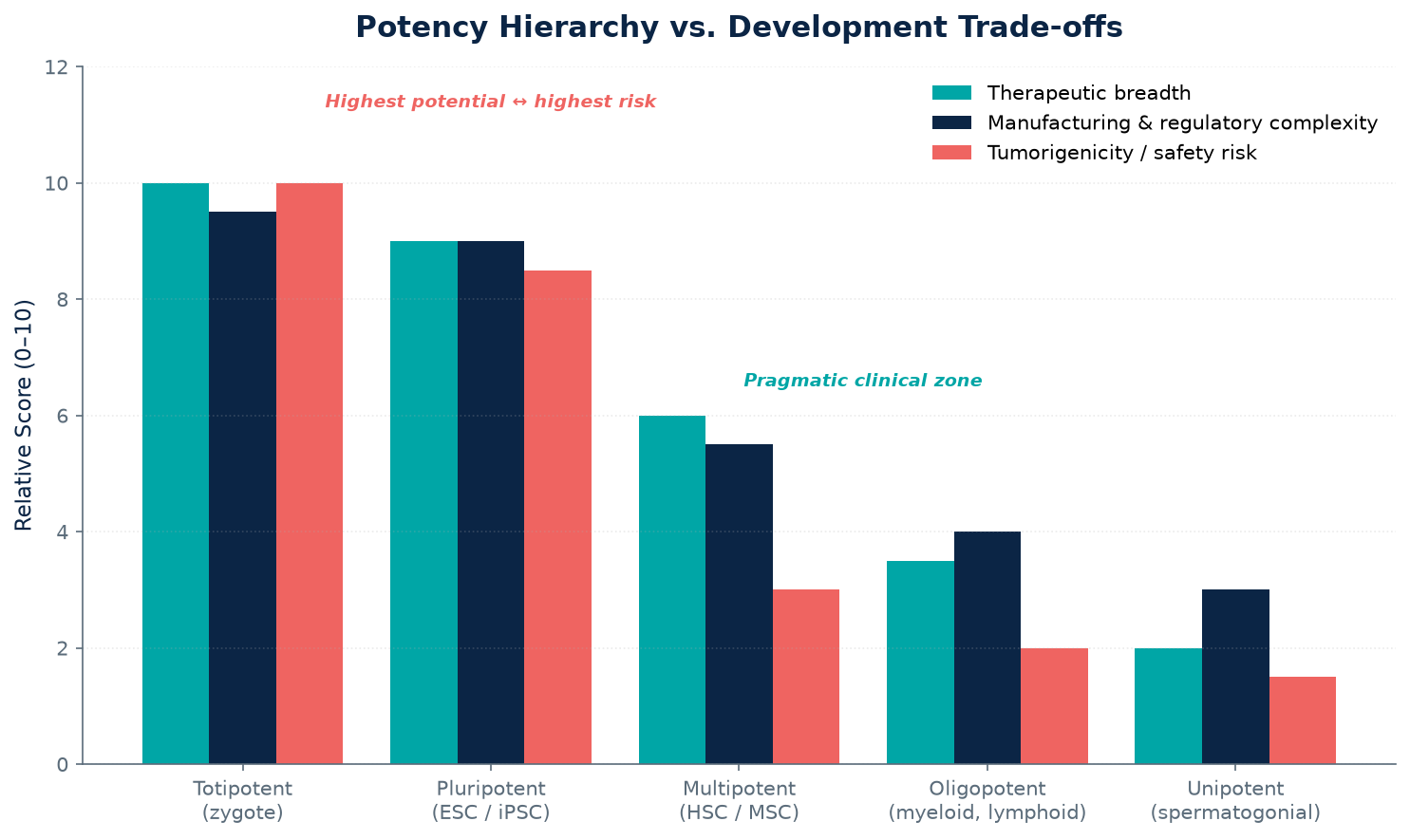
The chart above shows what I call the inverse-potency principle: the higher the potency, the higher both your therapeutic upside and your manufacturing/regulatory drag. That principle is the single most important framing for product managers deciding where on this ladder to build.
2. The Five Potency Tiers and How to Choose One
Every operator I've worked with in this space eventually asks the same question: if we're going to build a cell therapy company, which tier do we bet on? Here's the honest cheat sheet, indication by indication.
Pluripotent (iPSC / ESC) — The Platform Bet
Choose when: You want a single master cell bank to spawn multiple SKUs, you have 8–12 years of runway, and you have the capital ($200M+) to fund the potency, tumorigenicity, and comparability packages regulators will demand.
Real-world 2026 examples:
- Vertex VX-880 / VX-264 (iPSC-derived pancreatic islets for T1D) — insulin independence demonstrated, Phase 3 underway (Vertex pipeline; Managed Healthcare Executive on Phase 3)
- BlueRock Therapeutics bemdaneprocel (iPSC-derived dopaminergic neurons for Parkinson's)
- Fate Therapeutics (iPSC-derived NK and T cells for oncology)
Signature risks: Teratoma formation (undifferentiated cells persisting), line-to-line variability across iPSC clones, and a regulatory dossier that runs into thousands of pages.
Multipotent (HSC / MSC) — The Pragmatic Bet
Choose when: You want to reach a registrational endpoint in 5–8 years, your indication has a defined lineage requirement, and you can tolerate donor-to-donor variability.
Real-world 2026 examples:
- Ryoncil (remestemcel-L-rknd) — First FDA-approved MSC product, for pediatric steroid-refractory acute GvHD, approved Dec 2024 (ISCT 2024 approvals recap)
- Alofisel (darvadstrocel) — Allogeneic adipose-derived MSC for perianal fistulas in Crohn's disease
- Casgevy (exa-cel) — Gene-edited autologous HSCs for sickle cell disease and beta-thalassemia (FDA approval)
- Omisirge (omidubicel-onlv) — Nicotinamide-modulated cord blood HSC, expanded label Dec 2025 (Summit Re update)
Signature risks: Batch heterogeneity, potency assays that don't predict clinical outcomes (a persistent MSC problem across indications like osteoarthritis), and donor supply-chain complexity.
Oligopotent / Unipotent — The Precision Bet
Choose when: You need a single well-defined tissue replacement with a straightforward potency assay. Holoclar (autologous limbal stem cells for limbal stem-cell deficiency, EU-approved) is the archetype.
Decision Framework
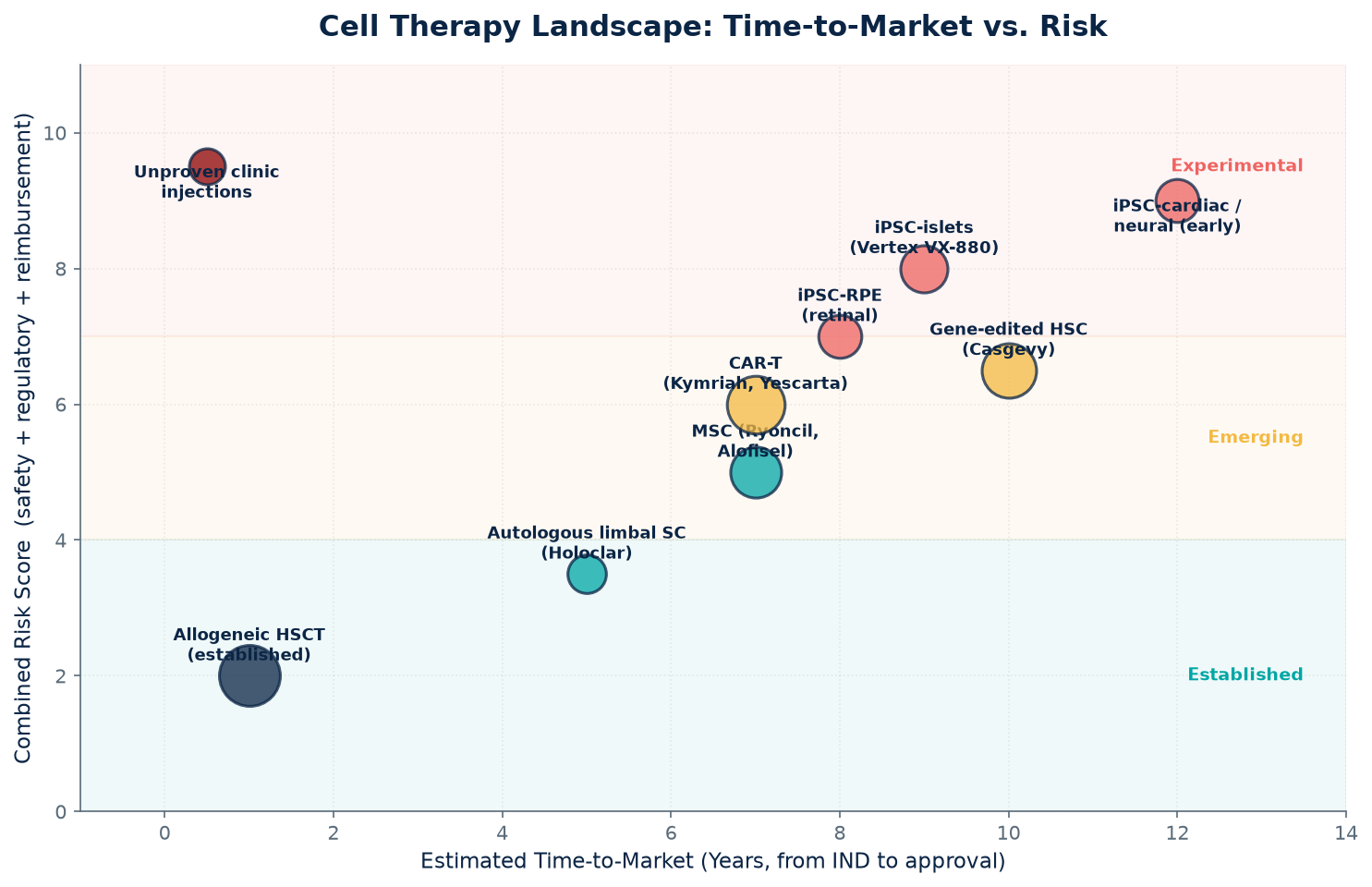
The scatter above places the major therapy classes on a time-to-market × risk grid. Read it as a portfolio-construction tool: established (HSCT, Holoclar) gets you revenue; emerging (Casgevy, Ryoncil, Alofisel, CAR-T) gets you defensibility; experimental (iPSC platforms) gets you a platform bet. The upper-left quadrant — high risk, no time investment — is where unregulated clinics live. Don't build there.
3. Market Size and Where the Money Actually Flows in 2026
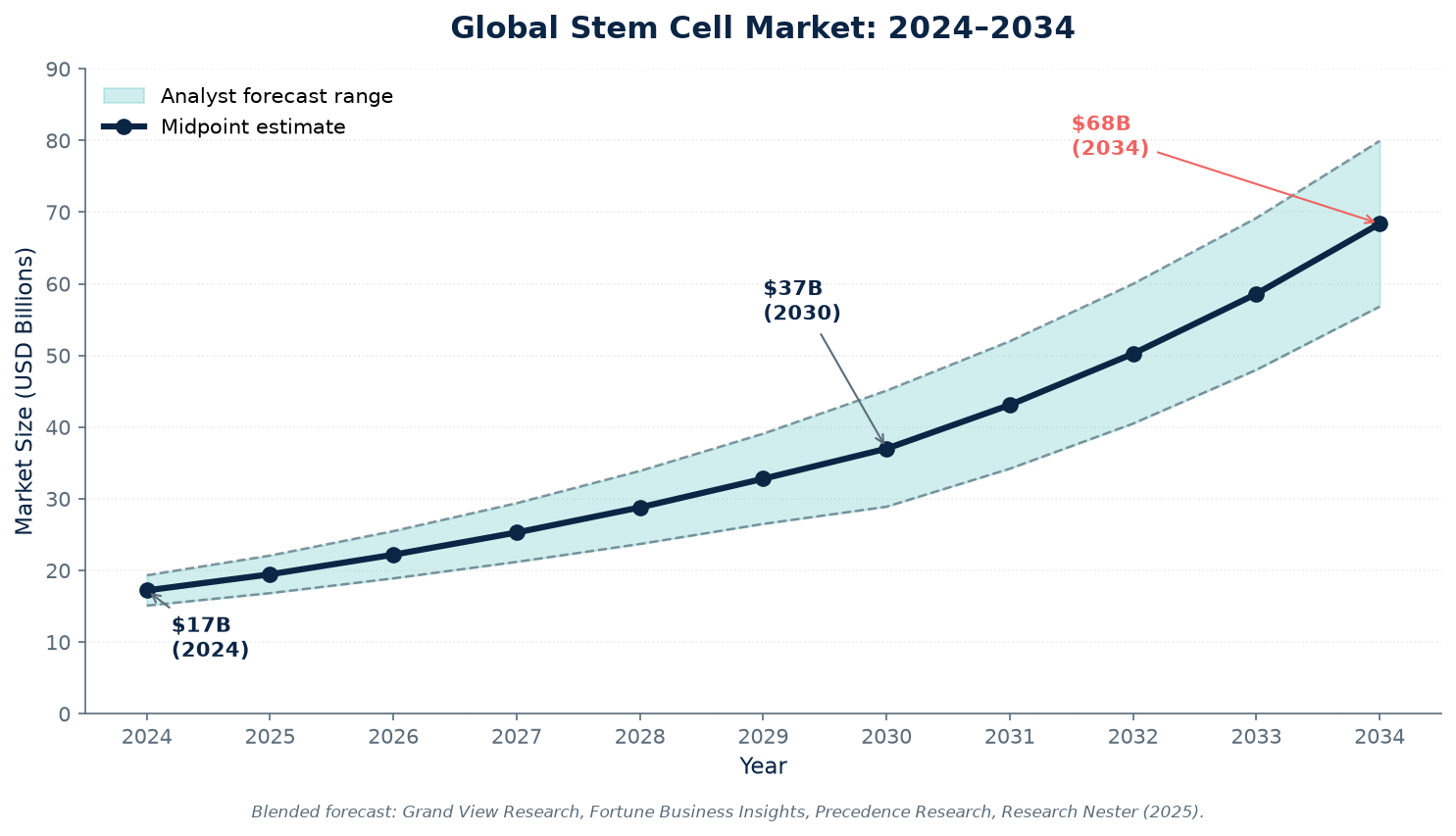
Analyst estimates cluster around $17–19B for the global stem cell market in 2024–2025, with wide dispersion in the outlook depending on how "regenerative medicine" is scoped:
| Analyst | 2024–2025 base | 2030+ forecast | CAGR |
|---|---|---|---|
| Grand View Research | $15.10B (2024) | $28.89B by 2030 | 11.4% |
| Fortune Business Insights | $19.34B (2025) | $79.95B by 2034 | 17.5% |
| Precedence Research | $18.65B (2025) | $53.32B by 2035 | 11.1% |
| Research Nester | $17.50B (2025) | $56.83B by 2035 | 12.5% |
North America commands ~53% of that market, with the U.S. representing the majority of both approved-product revenue and clinical trial activity (Fortune Business Insights).
Where the money actually flows
I split the revenue into four buckets when I model this for clients:
- Approved therapies — HSCT dominates by volume; Casgevy alone lists at $2.2M per patient, Lyfgenia at $3.1M (ACMG bulletin on approvals).
- CDMOs / manufacturing services — Companies like Lonza, Catalent, and hCbio absorb the CAPEX so smaller developers don't have to.
- Research tools and reagents — Stemcell Technologies, Miltenyi Biotec, and Thermo Fisher; the "picks and shovels" layer.
- Software and informatics — Benchling, LabVantage, and specialized cell-therapy MES vendors. This is the layer where a software engineer or founder without wet-lab expertise can actually build a company.
If you're a founder without a PhD, the software/informatics layer is where I'd point you first. It's growing faster than the underlying therapeutic market because every new approved therapy creates new documentation, traceability, and QC requirements.
4. Sources, Collection, and the Audit Trail That Saves Your Program
I've seen more early-stage programs collapse from bad sourcing than from bad science. The pattern is always the same: a founder cuts a corner on donor documentation or vendor QC in year one, hits IND-enabling studies in year three, and discovers that their entire dataset has provenance gaps regulators can't accept.
Common Sources by Cell Type
| Source | Cell types | Typical vendor model | Regulatory notes |
|---|---|---|---|
| Bone marrow aspirate | HSCs, MSCs | Hospital/clinical collection + CDMO expansion | HCT/P or biologic depending on manipulation |
| Cord blood | HSCs | Public/private cord blood banks (NMDP, CBR) | FDA-licensed CB units required for clinical use |
| Adipose tissue | MSCs, ADSCs | Liposuction under GMP consent | Watch: "minimally manipulated" carve-out no longer applies to most cultured products |
| Peripheral blood | HSCs (after G-CSF mobilization), T cells for CAR-T | Apheresis centers | Well-established; the CAR-T supply chain |
| Somatic cells → iPSCs | Fibroblasts, PBMCs reprogrammed | In-house or CDMO reprogramming | Requires genomic surveillance of every iPSC line |
| Embryonic tissue | ESCs | Licensed ESC lines (NIH registry, WiCell) | Consent traceability critical; jurisdictional restrictions |
The Sourcing Contract Template
When I audit a client's supplier contracts, these are the seven clauses I now require in every one. Copy them:
[SOURCING CONTRACT CHECKLIST — MINIMUM TERMS]
1. QC ACCEPTANCE CRITERIA
   - Viability threshold (e.g., ≥85% at receipt)
   - Sterility, mycoplasma, endotoxin certificates required
   - Identity markers by flow cytometry with target ranges
   - Right to reject lot at time of receipt with full credit
2. RAW DATA DELIVERY
   - Raw FCS files, sterility reports, and COA in machine-readable form
   - Delivered no later than lot ship date
3. CHAIN OF CUSTODY
   - Vendor maintains and provides on request:
     donor consent form, collection timestamp, anticoagulant used,
     ischemia time, storage/shipping temperature log
4. RIGHT TO AUDIT
   - Advance-notice right to audit the vendor's facility annually
   - Reasonable access for regulatory representatives
5. NOTIFICATION OF DEVIATION
   - Written notification within 5 business days of any manufacturing
     deviation affecting delivered lots (past or future)
6. INDEMNIFICATION
   - Vendor indemnifies for claims arising from consent, provenance,
     or QC failure in the delivered material
7. TERMINATION FOR CAUSE
   - Right to terminate for repeated QC failures, without
     penalty and with return/replacement of paid material
The cost of adding these clauses upfront is roughly zero. The cost of trying to fix them after the FDA asks about your provenance is measured in years and IND holds.
Common failure modes and how to avoid them
- Undetected mycoplasma — One upstream sterility check before scale-up heads off an estimated majority of downstream contamination cascades. Add it as a pre-expansion gate, not a post-expansion audit.
- Cold-chain breaches — Use temperature-logging tags on every shipment. A single Bluetooth logger costs less than $20. Litigation from an unlogged cold-chain incident costs six figures minimum.
- Consent scope drift — Maintain modular consent templates: a research tier, a commercial-development tier, and a broad-license tier. Sourcing something under research consent and then trying to commercialize it later is one of the fastest ways to lose an entire cell bank.
- Single-supplier risk — Dual-source everything critical. The 2022–2023 supply squeeze on GMP-grade cytokines killed timelines at multiple companies I know of.
5. Lab Techniques and QC — The Fit-for-Purpose Framework
Every team over-engineers QC in one direction and under-engineers it in another. The framework I use with clients has three levels:
| Stage | Required QC Depth | Cost Range (per batch) | Rationale |
|---|---|---|---|
| Discovery / R&D | Identity + viability + mycoplasma | $200–$800 | Fast iteration; catch obvious failures cheaply |
| Translational / IND-enabling | Add karyotype + tumorigenicity screen + potency (surrogate) + comparability | $3,000–$12,000 | De-risk before you spend $10M on Phase 1 |
| Manufacturing / GMP | Full release panel: identity, purity, sterility, endotoxin, mycoplasma, adventitious agents, potency (functional), stability | $8,000–$40,000+ | Regulator expectations; batch release for patient dosing |
The QC Assay Menu
The choice of assay is where most engineers I've worked with get lost. Here's the working menu:
Identity assays
- Flow cytometry — fast, quantitative, cheap; requires validated antibody panels
- Immunostaining — supplemental, catches missed populations
- Transcriptomic signatures (targeted qPCR panels, RNA-seq) — highest resolution, slowest turnaround
Potency assays
- Pluripotent products: teratoma assay (in vivo), directed differentiation panel, gene-expression score (OCT4, SOX2, NANOG)
- HSC products: CFU assay, chimerism testing after transplant
- MSC products: secretome profiling, T-cell suppression assay (an evolving space; regulators expect potency to be mechanistically linked, not just correlated)
- iPSC-derived differentiated products: lineage-specific functional assay (contractility for cardiomyocytes, insulin secretion for islets, electrophysiology for neurons)
Safety/genomic assays
- Karyotype (G-banding or higher-resolution)
- Targeted mutation panels (TP53, oncogene hotspots)
- Residual undifferentiated cell assay (for pluripotent-derived products) — a specific FDA expectation
The Informatics Stack
For a founder or engineer building this from scratch in 2026, my recommended default stack is:
| Layer | Options I've seen work | What to demand |
|---|---|---|
| ELN | Benchling, LabArchives, SciNote | 21 CFR Part 11 mode; API access; project templates |
| LIMS | LabVantage, STARLIMS, Sapio | Sample lifecycle, chain-of-custody, GMP-ready audit trail |
| MES (manufacturing execution) | Werum PAS-X, Rockwell PharmaSuite, or custom on LIMS | Electronic batch records, deviation workflow |
| Analytics | Databricks or Snowflake + Python | Native lot-genealogy queries; regulator-friendly SQL export |
| QMS | MasterControl, Veeva Vault QMS | CAPA workflows; SOP versioning |
A trap for engineers: don't try to build all five layers yourself. Buy the LIMS and ELN, integrate them into your data warehouse, and build the analytics/dashboarding layer in-house. That's where you can actually add product value.

KPIs Every Cell Therapy Program Should Track
- First-pass release rate (% of batches passing every release spec on first attempt)
- Cycle time (tissue collection → dose released)
- Cost per released dose (all-in, including scrapped batches)
- Deviation rate (deviations per 1,000 process steps)
- Assay drift (rolling 90-day trend on control samples)
- Time-to-detect for a QC anomaly (from event to alert)
If you can't produce these six numbers on demand for your board or a regulator, your informatics stack is not yet fit for purpose.
6. Clinical Applications in 2026: What's Approved, What's Next
Here is the clean-sheet map I now use in every strategy deck.
On-market and validated (2026)
- Hematopoietic stem cell transplantation (HSCT) — 60+ years of clinical experience; ~50,000+ procedures per year worldwide. The proof-of-concept for the entire category.
- Casgevy (exa-cel) and Lyfgenia (lovo-cel) — Gene-edited autologous HSCs for sickle cell disease and (Casgevy) transfusion-dependent beta-thalassemia. FDA approved Dec 8, 2023 (FDA press release).
- Ryoncil (remestemcel-L-rknd) — First FDA-approved MSC product; pediatric SR-aGvHD; approved Dec 2024 (ISCT recap).
- Alofisel (darvadstrocel) — EMA-approved allogeneic MSC for perianal fistulas in Crohn's disease.
- Holoclar — EMA-approved autologous limbal stem cells for limbal stem cell deficiency.
- Temcell — Japan-approved MSC for GvHD under the country's regenerative medicine framework.
- Omisirge (omidubicel-onlv) — Cord-blood-derived HSC with expanded label as of Dec 2025 (Summit Re update).
- CAR-T therapies — Kymriah, Yescarta, Breyanzi, Tecartus, Abecma, Carvykti, and 2024's Amtagvi/Aucatzyl/Tecelra. Autologous engineered T-cells; the closest analog to what iPSC-derived therapies aspire to become.
Late-stage and imminent
- Vertex VX-880 (iPSC-derived islets, T1D) — Insulin independence achieved in Phase 1/2; Phase 3 underway (PubMed overview of iPSC/ESC islet trials; Vertex pipeline).
- BlueRock bemdaneprocel (iPSC-derived dopaminergic neurons, Parkinson's) — Phase 2/3 in progress.
- Sernova, Semma-successor programs — Encapsulated islets in T1D.
Early clinical / experimental
- iPSC-derived retinal pigment epithelium (RPE) for AMD — RIKEN (Japan) and multiple U.S. programs; the landmark demonstration of iPSC transplantation feasibility.
- iPSC-derived cardiomyocytes for heart failure — Heartseed, Cellino, and academic programs.
- HLA-homozygous iPSC banks as an economics play to reduce allogeneic immune barriers.
The "should not be on-market" category
Unproven clinic offerings — MSC injections for osteoarthritis, "stem cell IV drips" for anti-aging, exosome infusions, umbilical cord blood for autism — sit in this bucket. There is no exosome therapy approved by the FDA as of 2026 (Bioinformant list of approved therapies; FDA consumer information on regenerative medicine). If you are building product or marketing in this category and touching any of these claims, you are one warning letter away from a shutdown. More on that below.
7. Manufacturing Economics and the Road to Sub-$100K Therapies
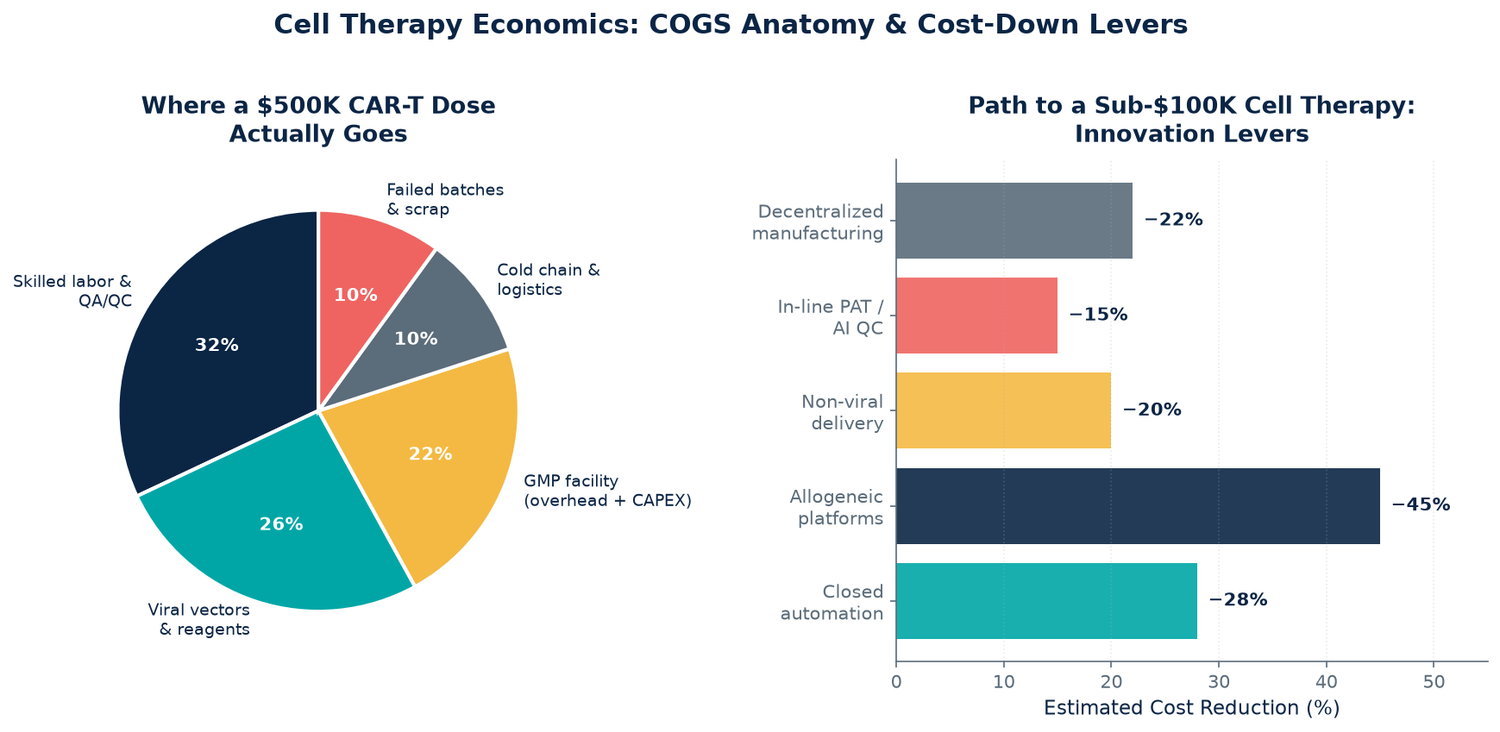
Cell therapy economics are brutal. A commercially manufactured CAR-T dose runs an estimated $400,000–$500,000 in direct COGS, with list prices commonly north of $500K and sometimes reaching $1M when you include workups and follow-up (IntuitionLabs on CAR-T COGS; ASCO on CAR-T cost). Casgevy at $2.2M and Lyfgenia at $3.1M exceed even those figures because of the additional gene-editing step and myeloablative conditioning (ACMG).
The good news: the industry has a credible line of sight to ~75% cost reduction over the next five years through a set of well-understood levers (Trends in Biotechnology on manufacturing innovation).
Where the money actually goes in a CAR-T-style dose
- Skilled labor + QA/QC (~32%) — Cell therapy remains labor-intensive; every deviation requires senior review.
- Viral vectors and reagents (~26%) — Lentiviral / AAV vectors are historically the highest single-line-item cost.
- GMP facility overhead / CAPEX (~22%) — Cleanroom air handling, environmental monitoring, validation cycles.
- Cold chain and logistics (~10%) — Cryogenic shipping for autologous products is expensive and failure-prone.
- Failed batches / scrap (~10%) — Autologous programs still see meaningful out-of-spec rates.
The five cost-down levers that actually matter
- Closed automation (Miltenyi Prodigy, Cocoon, Lonza Cocoon-like systems) — Reduce operator variance, cut labor 30–40% (~-28% total COGS impact).
- Allogeneic platforms (off-the-shelf products from banked cell lines) — The biggest single lever; if you solve immunogenicity, you get order-of-magnitude scale (~-45%).
- Non-viral delivery (electroporation, mRNA, transposons) — Removes viral-vector supply-chain bottleneck (~-20%).
- In-line PAT + AI-driven QC — Real-time bioreactor monitoring replaces destructive sampling (~-15%).
- Decentralized / point-of-care manufacturing — Bring the manufacturing to the hospital instead of shipping cells to a central facility (~-22%). Still experimental but tracked by KPMG and others as the aspirational endgame (KPMG on the $30K CAR-T).
For product managers: your CAPEX and pricing model should assume 2028–2030 COGS, not 2026 COGS. Payers will re-negotiate as those cost reductions arrive, and companies that can't demonstrate a cost-down roadmap won't secure formulary access.
8. Regulatory, Ethical, and Compliance Realities
The 2024 appellate ruling and the 2025 Supreme Court's decision not to hear the appeal permanently changed the compliance calculus in this space (PMC review on FDA authority; CalMatters). Cultured stem cell products are biologics. Full stop. There is no "practice of medicine" loophole for expanded-indication injections. There is no "same surgical procedure" carve-out for adipose-derived cultured products.
The Classification Cheat Sheet
| Product profile | U.S. classification | Path |
|---|---|---|
| Minimally manipulated + homologous use + no combination with drug/device | HCT/P under Section 361 | Registration only |
| Culture-expanded, gene-edited, or non-homologous use | Biologic drug (BLA) | Full IND / BLA required |
| Bone marrow, mobilized peripheral blood, cord blood for hematopoietic reconstitution | Section 361 for standard indications | Registration; established pathway |
| Cultured MSCs, iPSCs, ESC-derived products | Biologic drug | IND / BLA |
In the EU, everything above the Section 361 line falls under ATMP (Advanced Therapy Medicinal Product) rules and requires EMA CAT (Committee for Advanced Therapies) review. Japan has a distinct regenerative-medicine framework that allows conditional approvals for products showing early clinical benefit — a real strategic option for programs that can generate first-in-human data in Japan.
Expedited Pathways You Should Know
- RMAT (Regenerative Medicine Advanced Therapy) designation — U.S. accelerated review with early FDA engagement
- Fast Track / Breakthrough — Traditional expedited paths, applicable to cell therapies
- PRIME (PRIority MEdicines) — EU equivalent
- Sakigake — Japan expedited review for innovative products
The 2024–2025 Enforcement Escalation
The FDA issued a record number of warning letters to unproven biologics firms in 2024 (The Niche coverage). Then in October 2024, the FDA sent an untitled letter to R3 Stem Cell over unapproved products for Lyme disease, diabetes, and other conditions (FDA press release on R3). Multiple clinics have been shut down; two ophthalmology clinics have been named in serious adverse-event reports involving vision loss.
If you are building or advising in this space, assume active FDA surveillance of your public claims and paid ads.
Data Integrity: The 21 CFR Part 11 / EU Annex 11 Requirements
Anything touching GMP or clinical data must meet:
- Audit trails on every record edit
- Electronic signatures with meaning + identity + intent
- Role-based access control
- Change control on validated systems
- Data retention (typically ≥ trial life + 15 years, longer for many products)
Software engineers: bake these in from day one. Retrofitting Part 11 compliance onto a non-compliant system doubles or triples the cost of every downstream module.
9. The Medical-Marketing Angle: LegitScript, Google, Meta, and Staying Alive on Ad Platforms
This is the section I get asked about most, so I'll be direct.

The Ad Platform Reality in 2026
Both Google Ads and Meta classify stem-cell and regenerative-medicine advertising as "restricted content" under their healthcare policies. That means an unauthenticated ad account will be paused, and repeat offenders will be permanently banned. Every credit-card chargeback and every negative Trustpilot review the platforms scrape becomes signal.
What actually gets through:
- LegitScript Healthcare Merchant Certification — Recognized by Google since 2019 and now expanded through 2026 with pharmacy attestation requirements (LegitScript on Google acceptance; Curve Compliance on 2026 GLP-1 rules). If you're a clinic offering FDA-approved cell therapies (e.g., a hospital doing HSCT), get certified.
- Meta Special Ad Category for Health and Wellness — Required for anything targeting health interests.
- YMYL (Your Money or Your Life) alignment — Google's search-quality raters review health content with heightened scrutiny; your landing pages must show provider credentials, medical review, and citations.
What does not get through — and will get your account banned:
- Any ad claiming cell therapy can "treat," "cure," or "heal" a condition that isn't on the product's approved label
- Before/after photos framed as therapeutic outcomes for non-approved indications
- "Stem cell IV drip," "regenerative injection," "exosome infusion" for anti-aging, chronic pain, joint indications (unless referring to a specific approved product with proper labeling)
- Any use of "FDA-approved" for a product or indication that isn't
- Testimonials for unapproved indications (FDA General Wellness Policy 2019; FTC Endorsement Guides Aug 2023 update via Raging Agency)
A Compliance-First Ad Copy Template
Here's a template I use for legitimate clinics offering approved therapies:
[HEADLINE]
Advanced [approved product name] Therapy at [Clinic Name]
[DESCRIPTION]
FDA-approved [product]. Board-certified [specialty] physicians.
Insurance and [payer] coverage evaluations available.
[LANDING PAGE MUST INCLUDE]
- Provider names, NPI numbers, and specialty board certifications
- Medical review byline with reviewer credentials and review date
- Link to the FDA-approved prescribing information
- Clear indication statement (matches the approved label exactly)
- Risk statement / boxed warnings if applicable
- Contact info with a physical address
- LegitScript badge (once certified)
[DO NOT INCLUDE]
- Testimonials for off-label uses
- Any efficacy claim not in the label
- "Cure," "reverse," "restore" language absent label support
- Before/after images without matching approved indications
The Marketer's Due-Diligence Checklist
Before you accept a stem-cell / regenerative-medicine client, run this list. If any answer is "no," walk away — the risk to your ad account and your reputation is asymmetric.
[CLIENT ONBOARDING DUE-DILIGENCE — REGENERATIVE MEDICINE]
☐ Does the clinic administer only FDA-approved products for their
  approved indications?
☐ Are the physicians board-certified in a relevant specialty?
☐ Is the clinic licensed in every state where they operate?
☐ Have they had an FDA warning letter in the last 5 years?
  (Check: fda.gov/inspections-compliance-enforcement-and-criminal-investigations/
   compliance-actions-and-activities/warning-letters)
☐ Do they have LegitScript certification or an active application?
☐ Have they had complaints on Trustpilot, BBB, or state medical boards?
☐ Does their marketing history contain "cure," "reverse," or
  disease-specific claims outside FDA-approved labels?
☐ Are they willing to have their landing pages, ad creatives, and
  testimonials reviewed by an outside compliance counsel?
☐ Do they have general liability + medical malpractice coverage
  that names the marketing agency as additional insured?
For AI-assisted ad workflows: do not let a generative tool write claims copy on autopilot for this vertical. I've seen ChatGPT produce a "reduces joint pain by 87%" line that would have gotten a client shut down. Use AI for structure, hooks, and A/B variants — but keep every claim gated behind a human reviewer with the approved label open on the second monitor.
10. Templates, Checklists, and Decision Matrices
Everything I've referenced above, consolidated in one place for copy-paste use.
10.1 Cell Type Selection Decision Matrix
| If your priority is… | Pick this tier | Expected time-to-IND | Expected time-to-BLA/MAA |
|---|---|---|---|
| Fastest clinical proof of concept | Multipotent (allogeneic MSC or autologous HSC) | 2–3 years | 5–8 years |
| Broadest platform / multiple SKUs | Pluripotent (iPSC) | 3–5 years | 8–12 years |
| Precision / single tissue | Oligopotent or unipotent | 2–4 years | 5–8 years |
| Curative gene-corrected therapy | HSC + gene editing | 4–6 years | 8–10 years |
10.2 Stage-Gated Development Roadmap (Product Manager Template)
STAGE 1: DISCOVERY  (Months 0–18)
  □ Target indication defined with clinical endpoint
  □ Cell source secured with dual-supplier plan
  □ Minimal identity + viability + sterility QC in place
  □ ELN standing up with project templates
STAGE 2: PRECLINICAL REPRODUCIBILITY  (Months 12–36)
  □ Master cell bank established and characterized
  □ Karyotype + tumorigenicity screening validated
  □ Surrogate potency assay defined and calibrated
  □ First LIMS integration; provenance traceable across every sample
  □ Vendor contracts signed with the seven-clause template
STAGE 3: GMP PROCESS LOCK  (Months 24–48)
  □ Process transferred to GMP suite (in-house or CDMO)
  □ Closed / automated process design where feasible
  □ Comparability study designed against research-grade process
  □ 21 CFR Part 11 mode enabled on ELN + LIMS + MES
STAGE 4: IND-ENABLING  (Months 36–60)
  □ Pre-IND meeting with FDA (or equivalent scientific advice with EMA/PMDA)
  □ IND-enabling toxicology + tumorigenicity complete
  □ Release panel finalized with mechanistically-linked potency assay
  □ RMAT / PRIME / Sakigake designation applications where applicable
  □ Payer landscape mapped; real-world evidence plan drafted
STAGE 5: CLINICAL EXECUTION  (Months 48+)
  □ First-in-human dosing with lot-level traceability to clinical records
  □ Long-term follow-up registry stood up
  □ Post-market surveillance software in production before approval
At every gate: cost-per-dose model updated; runway re-forecast.
10.3 Engineer's Data Model Requirements
A minimum viable data model for a cell therapy program needs the following entities linked by immutable IDs:
- Donor → Consent → Collection Event → Sample
- Sample → Processing Step (n) → Sub-sample (n)
- Sub-sample → QC Assay Run (n) → QC Result (n)
- Sub-sample → Batch → Released Dose
- Released Dose → Patient (via de-identified subject ID) → Clinical Outcome (n) → AE Report (n)
Every entity must carry: created_by, created_at, modified_by, modified_at, and a signed audit trail of every change. Design your schema so that a regulator's question — "Show me every sample derived from Donor X and every clinical outcome linked to it" — resolves in a single SQL query.
10.4 The Compliance-First Marketing Checklist
Consolidated from Section 9 for standalone use:
[REGENERATIVE MEDICINE AD COMPLIANCE — GO/NO-GO]
Product/service in the ad:
  □ Is it an FDA-approved product? __________ (yes/no)
  □ Is the claimed use in the FDA-approved label? __________
  □ If foreign approval, is the ad geo-targeted only to that market? __________
Advertiser:
  □ LegitScript certified? __________
  □ Google Merchant certified? __________
  □ Meta Special Ad Category enabled? __________
  □ State licensure verified in every geo-targeted state? __________
Creative:
  □ No "cure," "reverse," "restore" claims outside label __________
  □ No testimonials for off-label indications __________
  □ No before/after imagery for unapproved indications __________
  □ Any percent-improvement stat cites a published trial or the label __________
Landing page:
  □ Provider names, credentials, and NPI __________
  □ Medical reviewer byline with review date __________
  □ Link to prescribing information / label __________
  □ Contact + physical address + terms __________
Legal:
  □ Copy reviewed by regulatory counsel (annually + on material changes) __________
  □ Client carries appropriate insurance with agency named __________
If any box is unchecked → do not launch.
11. Conclusion and Next Steps
The stem-cell category has finally split into two clean worlds. One world contains real approved therapies — Casgevy, Ryoncil, Alofisel, HSCT, Holoclar, and a pipeline of iPSC-derived products that are producing insulin-independence data that would have sounded like science fiction in 2021. The other world contains unregulated clinics that the FDA has, after a decade of court fights, been given clear authority to shut down.
For product managers, engineers, and founders building in this space, the operating principles I'd leave you with are these:
- Choose your potency tier deliberately. Pluripotent products buy you platform breadth at the cost of 8–12 year timelines and $200M+ regulatory bills. Multipotent products get you to market faster but with narrower indications.
- Regard manufacturing and data infrastructure as first-class product requirements. The cost of retrofitting Part 11 compliance, provenance, and comparability data at IND stage will exceed the cost of building them in from the start by an order of magnitude.
- Design for the 2030 cost curve. Assume allogeneic platforms, closed automation, and non-viral delivery will bring COGS down by ~75%. Your pricing model, payer strategy, and CAPEX plan should reflect that trajectory.
- Do not touch unregulated claims. If you are marketing or building product-adjacent tools in this vertical, ban "cure," "reverse," "restore," and off-label testimonials from every asset you produce. The asymmetric downside is not worth any short-term acquisition lift.
- Use AI aggressively for structure, not claims. Generative tools accelerate content, ad variants, and internal documentation. They do not review labels for you. Keep a human — ideally with regulatory counsel on speed dial — between AI and any patient-facing claim.
The next decade of this category will be won by teams that can execute across biology, manufacturing, data, and compliance simultaneously. Every one of those disciplines is now well enough understood that no single one is an excuse to fail on the others.
12. References
Primary regulatory source (major):
- U.S. Food and Drug Administration — Approved Cellular and Gene Therapy Products. The canonical, continuously updated FDA list of licensed cell and gene therapies.
Additional peer-reviewed and industry sources:
- FDA press release — "FDA Approves First Gene Therapies to Treat Patients with Sickle Cell Disease" (Dec 8, 2023). Casgevy and Lyfgenia approval.
- International Society for Cell & Gene Therapy — "Cell & Gene Therapy Approvals in 2024" (Jan 2025). Recap including Ryoncil, the first FDA-approved MSC product.
- Grand View Research — "Stem Cells Market Size & Share Report, 2025–2030". Market size, CAGR, and segmentation for the global stem cell market.
- Fortune Business Insights — "Stem Cells Market Size, Share, Growth Global Report [2034]". Long-range forecast and regional distribution through 2034.
- Precedence Research — "Stem Cells Market Size To Hit USD 53.32 Bn By 2035". Ten-year market forecast.
- Casgevy and Lyfgenia therapeutics bulletin — American College of Medical Genetics and Genomics, via PMC. Clinical and pricing detail on the gene-edited stem cell approvals.
- PMC review — "FDA must regulate stem cell therapies to mitigate risks to patients and the public" (2025). Analysis of the 2024 appellate ruling and 2025 Supreme Court decision.
- CalMatters — "Some California stem cell clinics use unproven therapies. A new court ruling emphasizes federal power" (2024). Journalism-quality coverage of the 2024 court ruling.
- FDA press release — "FDA puts company on notice for marketing unapproved stem cell products" (R3 Stem Cell). Representative enforcement action.
- The Niche — "Big spike in FDA warning letters to unproven biologics firms" (2024). Enforcement escalation analysis by Prof. Paul Knoepfler.
- PubMed — "Overview of the Major Clinical Trials Investigating Stem Cells-based" therapies for T1D (2026). Vertex VX-880 and the iPSC/ESC islet-cell trial landscape.
- Vertex Pharmaceuticals R&D Pipeline — Type 1 Diabetes. Current status of VX-880 and VX-264 iPSC-islet programs.
- IntuitionLabs — "CAR-T Manufacturing Cost of Goods Sold: Vein-to-Vein Analysis". Peer-review-based COGS breakdown for commercial CAR-T.
- Trends in Biotechnology — "Manufacturing innovation to drive down cell therapy costs" (ScienceDirect). The ~75% cost-reduction pathway analysis.
- ASCO — "High Cost of Chimeric Antigen Receptor T-Cells: Challenges and Solutions". Payer perspective and per-patient cost data.
- KPMG — "The USD 30k CAR-T therapy: a future within reach?". Strategic-consulting view of the sub-$100K cell therapy roadmap.
- Bioinformant — "List of U.S. FDA Approved Cell and Gene Therapy Products". Independent tracker of licensed products.
- LegitScript — Google Healthcare Merchant Certification. Ad-platform certification framework.
- Curve Compliance — "GLP-1 Advertising Rules in Late 2026". Google/Meta 2026 healthcare-advertising policy analysis.
- Raging Agency — "Wellness Ad Compliance Guide: Meta SAC, LegitScript, YMYL". Practical marketer's compliance overview.
- FDA — "Important Patient and Consumer Information About Regenerative Medicine Therapies". Consumer-facing regulatory statement.
- Summit Re — "Cell & Gene Therapy Approval Updates" (Dec 2025). Current approval tracker including Omisirge expanded indication.
This article was drafted with a business-operator lens and reviewed against publicly available regulatory records as of August 2026. Nothing in it is medical, legal, or regulatory advice. Consult qualified counsel before making product, marketing, or clinical decisions.
Prefer the PDF version? Download the full 27-page playbook →
Related services at PrimeCell
PrimeCell is a physician-led practice in Orlando. Candidacy for any procedure is determined at an in-person evaluation.
Ready when you are
Talk with a physician about your options
Have questions about whether this is right for you? Book a consultation with Dr. Chantasi, or call the clinic and we'll talk it through.
Orlando, FL · Mon–Fri 10am–6pm