
Aesthetics
How Long Do Collagen Stimulators Like Sculptra Really Last?
Sculptra and Radiesse work differently than fillers. Here's how long results actually last, who's a candidate, and what the evidence shows.
Poly-L-lactic acid injections such as Sculptra typically show gradual improvement over 2–3 months. Published data reports results observed for up to about 25 months in some patients (U.S. Food and Drug Administration, 2004).
Calcium hydroxylapatite products such as Radiesse generally last 12–18 months (Cosmetic Injectables, n.d.).
Neither product gives an immediate, permanent result. Both work by prompting the body’s own collagen response over weeks to months. How long that response holds up varies by person.
What This Means
“Collagen stimulator” is a different category than a standard hyaluronic acid filler.
Instead of physically filling space under the skin, these products trigger a biologic response. The body builds new collagen around the injected material over several weeks.
That’s why results appear gradually instead of right away. It also explains the fade timeline: months to years, not days.
Sculptra (poly-L-lactic acid, or PLLA) tends to last longer. It is often cited in the 2- to 3-year range. The newly formed collagen itself does the work, not the injected material (Cosmetic Injectables, n.d.).
Radiesse (calcium hydroxylapatite, or CaHA) gives more immediate volume plus a collagen-stimulating effect. Its microspheres are metabolized faster, though. That shortens the typical duration to roughly 12 to 18 months.
Candidacy
A reasonable candidate usually has mild to moderate volume loss or fine lines. They understand that results build gradually. They are not looking for an immediate, dramatic change.
Both PLLA and CaHA are FDA-approved for specific indications when used by a trained provider (U.S. Food and Drug Administration, 2004). Those indications include:
- Correction of nasolabial fold contour deficiencies and other facial wrinkles
- Correction of facial fat loss (lipoatrophy) associated with HIV
People who are not good candidates typically include those with:
- Active skin infections near the injection site
- A history of keloid or hypertrophic scarring
- Known hypersensitivity to any product component
- Unrealistic expectations about timeline and permanence
Anyone considering treatment near the eyes should raise it directly. Periorbital injection has been linked to a higher rate of visible papules and nodules (Utah Facial Plastics, n.d.).
Clinical Evaluation
Before recommending any injectable, a clinician should do three things:
- Take a history, including prior filler or biostimulator treatments, allergies, and bleeding risk
- Examine the treatment area
- Discuss goals in plain terms
This is also where options get discussed. Not every patient who wants “more volume” or “fewer lines” is best served by a collagen stimulator.
A thorough evaluation also includes:
- Reviewing photographs over time when available
- Assessing skin quality and the degree of volume loss
- Setting expectations about the number of sessions typically needed
Most protocols call for 2–4 sessions of Sculptra, spaced several weeks apart. Visible improvement builds over that period rather than appearing after one visit.
Available Options
Collagen stimulators are one option among several for facial volume loss and fine lines:
- Hyaluronic acid (HA) fillers: immediate volume, more predictable and reversible with hyaluronidase. Duration is usually shorter than PLLA.
- Calcium hydroxylapatite (Radiesse) — immediate volume plus a collagen-stimulating effect, moderate duration (roughly 12–18 months).
- Poly-L-lactic acid (Sculptra) — no immediate volume; gradual collagen buildup over months, longer duration (often cited around 2–3 years).
- Energy-based skin treatments (radiofrequency, microneedling with radiofrequency, certain lasers): collagen-stimulating without injection. Expect more sessions and more modest volume change.
- Doing nothing, or plain skin care: a legitimate choice for people who prefer not to pursue an injectable at all.
A clinician should walk through these options and their tradeoffs. No single product should be presented as the only path forward.
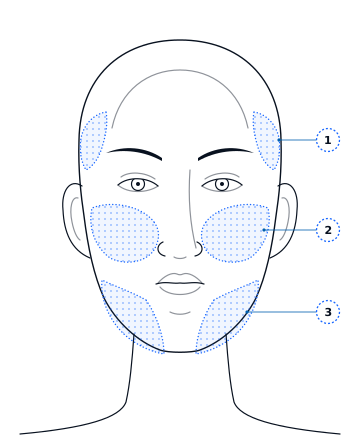
Collagen stimulators
- 1Temples. The hollow at each side of the forehead, beside the eye.
- 2Midface and cheeks. Across the cheekbone and below it.
- 3Lower face and jawline. Along the jaw toward the chin.
Dotted, stippled regions: these products are spread across an area, often over a series of visits, and the change builds gradually. Approval covers specific areas for each product; use elsewhere is off-label. Illustration of typical injection areas, for education. Not a photograph or a result. Where and how much is injected is decided at your evaluation.
Benefits, Limitations & Risks
Benefits:
- Gradual, natural-looking improvement in facial volume and skin firmness
- Longer duration than many standard fillers, for PLLA specifically
- FDA-approved indications for defined uses
Limitations:
- Results are not immediate
- PLLA takes multiple sessions
- Results are not permanent; everyone returns close to their baseline appearance without maintenance treatment
Outcomes vary by individual skin quality, technique, and dosing. They are not guaranteed.
Risks: the most common side effects are:
- Injection-site bruising
- Pain
- Swelling
- Redness
Most resolve within days to about two and a half weeks (Drugs.com, n.d.).
Small nodules or lumps under the skin can occur. They are reported in roughly 0.4%–2% of cases with proper technique, dilution, and post-treatment massage. Some require corticosteroid injection or, rarely, surgical removal (Utah Facial Plastics, n.d.).
As with any injectable, rarer but more serious risks include infection, vascular injury, and nerve trauma.
These risks should be discussed directly with a licensed provider before treatment. This article does not replace that conversation.
What the Evidence Shows
Current evidence supports two points. PLLA and CaHA stimulate measurable new collagen production. Clinical improvement is visible on standardized photography for many patients. FDA clearance rests on trials for their specific approved indications (U.S. Food and Drug Administration, 2004).
Duration estimates run roughly 2–3 years for PLLA and 12–18 months for CaHA. Those figures come from manufacturer and published clinical data, not from every patient’s experience.
The evidence does not establish any of the following:
- A guaranteed outcome for any individual
- A precise duration for a specific patient
- Superiority of one product over another for every situation
Head-to-head, long-term comparative trials between specific products remain limited.
Some claims promise permanent results. Others promise a look identical to a specific influencer or before-and-after photo. The evidence supports neither, and both should be treated skeptically.
Recovery / Next Steps
Most patients return to normal activities the same day. Mild swelling, redness, or bruising at injection sites can last a few days to about two and a half weeks (Drugs.com, n.d.).
Massage of the treated area is often advised after Radiesse, and sometimes after Sculptra. Follow the specific protocol the injecting clinician provides. Massage helps spread the product evenly and may lower the risk of visible nodules.
For Sculptra, the next step after a first consultation is usually scheduling the first of 2–4 sessions. Those sessions sit about four to six weeks apart. A follow-up visit after the series judges whether extra touch-up sessions are useful.
Orlando Considerations
Florida’s warm climate and strong sun make sun protection matter after any injectable procedure. UV exposure and heat can worsen swelling and bruising in the days after treatment.
Orlando’s cash-pay aesthetic medicine market holds a wide range of providers with varying levels of training. Before scheduling, check that your injector is one of the following, working within their scope of practice:
- A licensed physician
- A physician assistant
- A nurse practitioner
Florida does not require a specific state certification for injectable procedures. A practitioner’s own medical license and standard scope-of-practice rules apply.
Frequently asked questions
Is Sculptra the same as a regular dermal filler?
No. Standard hyaluronic acid fillers add volume directly and show results right away. Sculptra (PLLA) works by stimulating the body’s own collagen production. Results appear gradually over weeks to months.
How many Sculptra sessions do most people need?
Most protocols involve 2–4 sessions spaced roughly four to six weeks apart. The exact number depends on the treatment area and how you respond.
Can collagen stimulator results be reversed if I don’t like them?
Not in the same way hyaluronic acid fillers can be dissolved with hyaluronidase. PLLA and CaHA work by prompting new collagen formation. They do not sit in place as a removable gel, so there is no direct reversal agent. That is another reason a thorough consultation before treatment matters.
Are collagen stimulators safe?
Both Sculptra and Radiesse are FDA-approved for specific indications. They have an established safety record when performed by a trained provider. They still carry real risks, including nodules, bruising, and rare but serious complications. Risks and candidacy should be discussed one on one with a licensed provider.
What happens when the effect wears off?
The skin gradually returns toward its pre-treatment appearance as the stimulated collagen is remodeled over time. Maintenance treatment is an option for patients who want to hold the result. It is not required.
This article is general education and is not a substitute for individual medical advice, diagnosis or treatment. Candidacy and results vary; decisions about care should be made with a qualified clinician.