
Aesthetics
What’s the Difference Between Collagen Stimulators and Fillers?
Collagen stimulators prompt your body to build collagen over months; fillers add volume immediately. How an Orlando physician compares the two.
The difference is timing and mechanism. A conventional dermal filler — usually hyaluronic acid — physically occupies space under the skin, so the change is visible the day it is placed. A collagen stimulator such as poly-L-lactic acid (PLLA) or calcium hydroxylapatite (CaHA) acts as a scaffold that prompts your own fibroblasts to lay down new collagen over weeks to months, while the material itself is gradually absorbed (Sickles et al., 2024). Both are FDA-approved injectable implants regulated as medical devices, and both carry real risks (U.S. Food and Drug Administration, 2023).
What This Means
Think of it as filling a low spot versus rebuilding the ground under it.
A hyaluronic acid filler is a gel. Once placed, it takes up volume and draws in water, so a fold or a flat cheek looks different immediately. If you dislike the result, most hyaluronic acid products can be dissolved.
A collagen stimulator is not doing that job. After the carrier fluid is absorbed — usually within two or three days — the visible change from the injection itself largely disappears, and what remains is a slow biological response (Sickles et al., 2024). The result builds across a series of sessions spaced several weeks apart (American Society of Plastic Surgeons, n.d.). It cannot be dissolved.
That single difference drives most of what follows: how many visits it takes, how long results last, and how much patience the approach requires.
Candidacy
Neither category suits everyone, and the decision usually hinges on what is actually causing the change you see.
Collagen stimulators tend to fit diffuse volume loss across a broad area — flattening in the temples, midface, or cheeks — where the goal is gradual restoration rather than precise sculpting. PLLA is FDA-approved for facial fat loss (lipoatrophy) in people with HIV and, in immunocompetent adults, for nasolabial fold contour deficiencies and other facial wrinkles (Sickles et al., 2024; U.S. Food and Drug Administration, 2004). Hyaluronic acid fillers tend to fit defined, localized targets: lips, a specific fold, chin projection.
Some people are candidates for neither. The FDA notes that safety has not been established during pregnancy or breastfeeding, in patients under 22, or in people prone to keloids or hypertrophic scarring, and that active skin infection or inflammation at the site should be resolved first (U.S. Food and Drug Administration, 2023). A documented allergy to a product’s components is an absolute contraindication for PLLA (Sickles et al., 2024).
Clinical Evaluation
A useful consultation is an assessment, not a menu.
An aesthetic evaluation at PrimeCell Regenerative includes a facial assessment for asymmetry and volume differences, a review of your medical history — bleeding disorders, anticoagulant or antiplatelet medication, allergies, keloid history, prior injectables and where they were placed — and baseline photographs. Anticoagulants are not stopped for these procedures, but they raise bruising and hematoma risk and change the counseling (Sickles et al., 2024).
Prior filler matters more than patients expect. Product placed years ago can still be present and can change what a new injection will look like. Mixing PLLA with other filler products at the same site is not recommended (Sickles et al., 2024).
The American Academy of Dermatology is direct about who should do this: results depend heavily on the experience of the injector, and a consultation should precede any injection (American Academy of Dermatology, n.d.). The FDA says it more plainly — filler injection is a medical procedure, and you should ask about the injector’s specific training (U.S. Food and Drug Administration, 2023).
Available Options
Injectables are one path among several, and not always the right one.
Hyaluronic acid fillers give immediate volume and are generally reversible and shorter-lived. Collagen stimulators — PLLA and CaHA — are gradual, series-based, and not reversible; PLLA’s duration of action is commonly cited as 12 to 24 months (Sickles et al., 2024). Neuromodulators work by a different mechanism entirely, relaxing muscle activity rather than adding volume, and fit dynamic expression lines better. Energy-based and resurfacing procedures address skin texture rather than deep volume. Daily sun protection and retinoids are unglamorous and genuinely effective over time. Surgery remains the option for advanced laxity, where no injectable substitutes for repositioning tissue.
Doing nothing is also a legitimate option, and a good consultation should put it on the table.
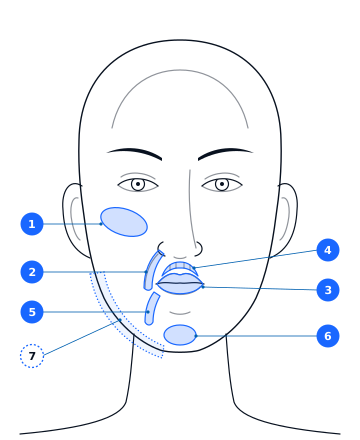
Hyaluronic-acid fillers
- 1Cheek (midface). Over the cheekbone.
- 2Nasolabial folds. The smile lines from nose to mouth.
- 3Lips. Volume and shape.
- 4Perioral lines. Fine vertical lines above the upper lip.
- 5Marionette area. Below each corner of the mouth.
- 6Chin. Projection and profile.
- 7Jawline. Along the jaw. Varies by patient and product.
Paired areas are drawn on one side only. Each product is FDA-approved for specific areas and ages; use elsewhere is off-label, and you are told which applies. Illustration of typical injection areas, for education. Not a photograph or a result. Where and how much is injected is decided at your evaluation.
Benefits, Limitations and Risks
Collagen stimulators can produce gradual, diffuse improvement that looks less placed than a large volume of gel, and the effect generally lasts longer. Fillers give immediate, precise, adjustable results and can usually be reversed.
The limitations are real. Collagen stimulators require multiple sessions — for lipoatrophy correction, the degree of correction tracks with the number of sessions, not the volume injected at each one (Sickles et al., 2024). Results take weeks to appear. Neither category lifts loose skin.
Bruising, swelling, redness, pain and tenderness are common with any dermal filler and usually settle within days to weeks (U.S. Food and Drug Administration, 2023). Less common are nodules or granulomas, infection, allergic reaction, and tissue necrosis. Nodule formation is a specific, well-described issue with PLLA, associated with lower dilution volumes and superficial placement (Sickles et al., 2024).
The most serious risk with any injectable filler is unintended injection into a blood vessel. It is uncommon, but reported consequences include tissue necrosis, vision loss, and stroke, and they may be permanent (U.S. Food and Drug Administration, 2023). Anyone who develops unusual pain, vision change, or blanching of the skin during or after an injection should seek immediate medical attention.
What the Evidence Shows
Established: PLLA and CaHA are FDA-approved injectable implants for specific facial indications, and PLLA’s degradation and collagen-induction pathway has been characterized in histologic work (Sickles et al., 2024; Christen, 2022).
Not established: the FDA’s approvals rest on controlled studies of use in the face and hands. The agency states that the safety of these products used repeatedly over long periods has not been evaluated in controlled study, and neither has their safe use in combination with neuromodulators or other procedures (U.S. Food and Drug Administration, 2023). Many popular body applications of PLLA — cellulite, skin laxity, gluteal and chest-wall areas — are off-label, with a thinner evidence base than the marketing suggests (Christen, 2022; Sickles et al., 2024).
There is no good head-to-head evidence declaring one category superior. They do different jobs.
Recovery and Next Steps
Most people return to normal activity the same day. Swelling, redness and bruising are typical for a few days and can take up to a week to settle (Sickles et al., 2024). Ice immediately afterward helps; sun exposure to the injected area should be minimized while healing.
After PLLA, injectors commonly ask patients to massage the area — a frequently used protocol is five minutes at a time, five times a day, for five days — as an anecdotal measure to reduce nodule risk (Sickles et al., 2024). Follow-up assessment two to four weeks later is standard, and further sessions are usually spaced three to six weeks apart.
Do not judge a collagen stimulator at two weeks. That is the wrong timepoint for how it works.
Orlando Considerations
Central Florida’s year-round sun exposure is relevant here, and not as a marketing line. Ultraviolet exposure contributes to the collagen loss that brings people in, and patients are advised to limit sun exposure to injected areas while the skin recovers (Sickles et al., 2024). Daily photoprotection does more for long-term skin quality in this climate than any single injection.
Florida also has an active medical-spa market with wide variation in who performs injections. The FDA’s guidance is to seek a licensed health care provider with dermatology or plastic surgery experience, to ask directly about training with the specific product, and never to buy filler online — counterfeit product is a documented problem (U.S. Food and Drug Administration, 2023).
Frequently asked questions
Is Sculptra a filler?
It is regulated as a dermal filler but does not behave like a hyaluronic acid gel. It is a collagen stimulator: the visible result comes from your own collagen response over months, not from the injected volume (Sickles et al., 2024).
Can collagen stimulators be dissolved if I don’t like the result?
No. Hyaluronic acid fillers can generally be dissolved with hyaluronidase. There is no antidote for PLLA (Sickles et al., 2024). That asymmetry is worth weighing before a first session.
How many sessions do I need?
It varies by individual and area. PLLA is typically given as a series spaced several weeks apart, and correction correlates with the number of sessions rather than the volume per session (Sickles et al., 2024).
Can I get both?
Some people do, in different areas or at different times. The FDA notes the safety of combining these products with neuromodulators or other procedures has not been evaluated in controlled study, and PLLA is not recommended to be mixed with other fillers at the same site (U.S. Food and Drug Administration, 2023; Sickles et al., 2024).
Which one lasts longer?
Collagen stimulators generally last longer — PLLA’s duration of action is commonly reported as 12 to 24 months (Sickles et al., 2024). Individual results vary considerably.
This article is for general education only. It is not medical advice, does not establish a physician-patient relationship, and should not be used to decide on any procedure.